On this page

Data governance for AI is the set of policies, controls, and ownership structures that determine which data trains your models, who can access it, how it transforms from source to inference, and when it must be deleted or replaced. Get those four things wrong and you get hallucinations, poisoned models, data leaks, and audit failures. Get them right and your AI outputs become reproducible, defensible, and trustworthy.
Three things to do in the next few days:
-
Inventory your training and inference data sources. Know what feeds your models before you can govern it. Undocumented sources are the single largest root cause of silent model failures.
-
Freeze any dataset currently being modified without a change log. Untracked mutations to training data are indistinguishable from model bugs until the postmortem.
-
Identify which AI tools your teams are using and whether PII or confidential data flows through them. Shadow AI tool use is the fastest path to an uncontrolled data leak.
These three actions align with the core obligations in the NIST AI Risk Management Framework, EU AI Act Article 10 (data governance requirements for high-risk AI), and ISO/IEC 42001, the international management system standard for AI. All three frameworks converge on the same starting point: know your data before you govern it.
Table of Contents
Why weak AI data governance breaks your models
Ordinary data problems become catastrophic inside AI pipelines. A mislabeled field in a relational database causes a bad report. The same mislabeled field in a training dataset causes a model that systematically produces wrong outputs at scale, often without any visible error signal.
Here are the primary failure modes, each with an illustrative example of how they surface:
-
Hallucination from low-quality or undocumented training data. A customer-facing LLM trained on unvetted internal documents begins citing policies that were deprecated two years ago. (Illustrative example.)
-
Model poisoning from unvetted third-party data. A team ingests a public dataset without provenance checks; the dataset contains adversarially crafted samples that shift the model’s classification boundary. (Illustrative example.)
-
Data leakage through inference. A generative model fine-tuned on customer records begins reproducing PII verbatim in responses to unrelated queries. (Illustrative example.)
-
Compliance gaps from undocumented data lineage. An auditor asks which training records contain EU resident data subject to GDPR right-to-erasure requests. No lineage exists. The team cannot answer. (Illustrative example.)
-
Silent drift from upstream pipeline mutations. A feature engineering job changes a normalization formula. No change log exists. The model’s accuracy degrades over six weeks before anyone connects the pipeline change to the performance drop. (Illustrative example.)
AI amplifies ordinary data problems in two specific ways. First, the feedback loop is delayed: a bad training batch today produces a degraded model weeks later, long after the causal link is obvious. Second, synthetic data creates recursive contamination when it is not tagged in lineage, causing models to train on their own generated outputs and collapse toward a narrower output distribution. Both failure modes are preventable with the controls described below.
PwC frames strong data governance not as a compliance burden but as a front-line business enabler that directly improves AI reliability and reduces hallucinations. That framing is correct, and it is the lens this guide uses throughout.
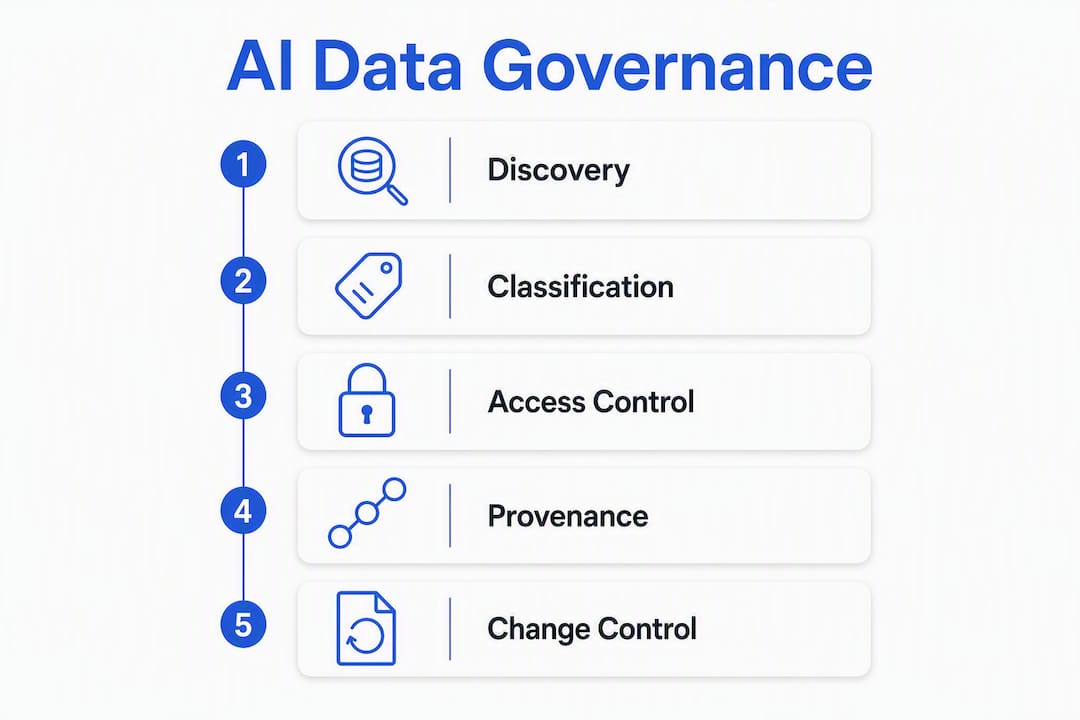
Core components every AI data governance program needs
KPMG analysts identify the biggest mistake as treating data governance and AI governance as separate workstreams. They are not. The controls below are integrated by design.

Discovery and classification
You cannot protect data you have not found. Discovery means cataloging every dataset that touches your AI pipeline: training corpora, fine-tuning sets, retrieval-augmented generation (RAG) knowledge bases, prompt templates, and inference logs. Classification assigns sensitivity tags at the field level: PII, PHI, confidential, public, synthetic.
-
Maintain a live catalog entry for every AI-relevant dataset (name, owner, sensitivity tier, permitted uses, retention date).
-
Apply field-level sensitivity tags using a consistent taxonomy (e.g., PII-Direct, PII-Quasi, PHI, Confidential-IP, Public).
-
Run automated discovery scans on data stores that feed model training or inference at least weekly.
-
Flag any dataset with no documented owner as ungoverned and block it from production training pipelines.
Pro Tip: Run your AI tool discovery scan before you build any other control. You will almost certainly find data flows you did not know existed, including SaaS AI tools that employees are using with company data outside any approved workflow.
Data quality for AI
Standard data quality checks (null rates, referential integrity) are necessary but not sufficient for AI. Models are sensitive to distributional properties that row-level checks miss entirely.
-
Define and enforce schema contracts at pipeline ingestion points; reject batches that violate them.
-
Track distributional statistics (mean, variance, skew, class balance) per dataset version, not just per run.
-
Set data quality SLAs: maximum acceptable null rate, minimum class representation, maximum feature drift threshold.
-
Require a data quality report as a prerequisite for any model training job.
Pro Tip: Treat data quality failures as pipeline failures, not data team tickets. If a batch fails a quality gate, the training job should not start. Automate the gate; do not rely on humans to remember to check.
Provenance and lineage
Provenance answers “where did this data come from and is it permitted for this use?” Lineage answers “how did it transform from source to model input?” Both are required to reproduce a model failure or respond to a right-to-erasure request.
-
Record source URL, acquisition date, license, and permitted-use scope for every external dataset.
-
Capture transformation lineage at the job level: input dataset version → transformation code version → output dataset version.
-
Tag synthetic data at creation time with provenance metadata and lifecycle policies so it is never mistaken for real-world observations.
-
Store lineage metadata in a system that is queryable by dataset ID, model ID, and data subject ID.
Pro Tip: If you cannot answer “which model versions were trained on data from source X?” in under five minutes, your lineage is not operational. That query is the first one a regulator or incident responder will ask.
Access and identity controls
AWS recommends federated access as the practical pattern: data stewards closest to the domain manage granular permissions, balancing security with experimentation speed. Centralized access control that requires a ticket for every data request kills iteration velocity without meaningfully improving security.
-
Enforce role-based or attribute-based access control (RBAC/ABAC) on all training data stores and model registries.
-
Apply the principle of least privilege: model training jobs get read-only access to exactly the datasets they need, scoped by version.
-
Enforce SSO and SCIM provisioning for all AI tools that touch production data.
-
Audit access logs quarterly; revoke stale permissions automatically after 90 days of inactivity.
Pro Tip: Scope training job credentials to a specific dataset version, not to the entire data lake. A misconfigured job that can read the whole lake is one bug away from a data exfiltration incident.
In-flight data protection
Standard governance tools frequently miss in-flight data: the prompts users send, the retrieved context chunks, and the inference cache. These artifacts contain sensitive data and are the primary evidence needed to reproduce a hallucination or a data-leak incident.
-
Deploy prompt-level redaction for all external LLM API calls; strip PII and confidential terms before the request leaves your network.
-
Log every prompt, retrieved context chunk, and model response with a unique request ID, timestamp, and user/session identifier.
-
Apply DLP (Data Loss Prevention) policies to file uploads and document inputs to AI tools.
-
Retain inference logs for a minimum period consistent with your incident response SLA (typically 90 days).
Pro Tip: Prompt redaction is not just a privacy control. It is the only way to reproduce an inference failure after the fact. Teams that skip it lose the ability to debug their own models in production.
Retention and deletion
AI systems create new retention obligations that most data retention policies were not written to handle: training datasets, model weights, inference logs, and evaluation benchmarks all have different retention needs and different deletion risks.
-
Define retention periods for each artifact class: training data, model weights, inference logs, evaluation sets.
-
Implement deletion propagation: when a data subject exercises a right-to-erasure request, identify every model trained on their records and assess retraining or model retirement.
-
Automate deletion of inference logs past the retention window; do not rely on manual cleanup.
-
Document retention decisions in the catalog entry for each dataset.
Third-party data vetting
Integrating data governance controls into procurement and vendor lifecycle processes prevents downstream risk when consuming third-party models or datasets. This is not a legal formality; it is a technical control.
-
Require a data provenance declaration from every third-party data vendor before ingestion.
-
Verify license scope: confirm the license explicitly permits the intended use (training, fine-tuning, RAG, commercial deployment).
-
Run automated quality and distribution checks on every third-party dataset before it enters a training pipeline.
-
Include AI-specific data terms in vendor contracts: permitted use, breach notification, data deletion on contract termination.
Dataset versioning and change control
Untracked dataset changes are the leading cause of unexplained model performance degradation. Versioning is not optional; it is the minimum viable control for reproducibility.
-
Assign an immutable version identifier to every dataset snapshot used in training or evaluation.
-
Require a change log entry for every dataset update: what changed, who approved it, what models were retrained.
-
Gate dataset promotion to production on a review step that includes a distribution comparison against the previous version.
-
Store immutable snapshots in write-once storage; do not allow in-place modification of versioned datasets.
Pro Tip: Treat dataset versions the same way you treat code commits: every change is logged, every promotion is reviewed, and rollback is always possible. A model trained on an unversioned dataset cannot be reproduced.
How to implement this in 90 and 180 days

Roles and responsibilities
| Role | Core Responsibilities | KPIs |
|---|---|---|
| Data Steward | Catalog maintenance, sensitivity tagging, access approvals, deletion execution | Catalog coverage %, open access requests resolved in <48 hrs |
| Model Owner | Dataset selection, training job approvals, model card authorship, drift response | Model performance SLA, time-to-detect drift |
| Security / DLP | Prompt redaction deployment, DLP policy management, access log review | Redaction coverage %, incidents from in-flight leakage |
| CDO / IT | Tooling procurement, SSO/SCIM enforcement, infrastructure for lineage capture | SSO coverage %, ungoverned tool count |
| Legal / Compliance | Third-party data contract review, right-to-erasure response, regulatory mapping | Contract review SLA, erasure request completion time |
90-day checklist
-
Weeks 1–3 (Discover). Run AI tool discovery. Inventory all datasets touching AI pipelines. Assign a data steward to each. Flag ungoverned datasets and block them from production training.
-
Weeks 4–7 (Protect). Deploy prompt-level redaction for top three external LLM integrations. Enforce SSO/SCIM on all AI tools. Implement field-level sensitivity tagging on highest-risk datasets. Run DPA gap checks against GDPR and CCPA obligations.
-
Weeks 8–12 (Control). Implement dataset versioning with immutable snapshots. Define and enforce data quality gates on training pipelines. Stand up lineage capture for at least the two highest-risk model pipelines. Conduct first access log audit; revoke stale permissions.
180-day extension
- Months 4–6 (Productionize and audit). Extend lineage capture to all production models. Automate deletion of expired inference logs. Complete third-party data contract reviews. Run a tabletop incident response exercise using the runbook below. Produce a governance evidence package mapped to NIST AI RMF, ISO/IEC 42001, and SOC 2 CC6.
Incident response runbook: data-related AI failures
When a data-related AI incident is suspected (hallucination, data leak, unexplained drift):
-
Triage (0–2 hours). Identify the affected model and the inference window. Pull request logs for the period. Determine whether the failure is reproducible from logged prompts and context.
-
Freeze (2–4 hours). Freeze the dataset version used in the last training run. Suspend any in-progress training jobs that use the same data source. Preserve inference logs as evidence artifacts.
-
Reproduce (4–24 hours). Attempt to reproduce the failure using logged prompts, retrieved context, and the frozen dataset version. Document whether reproduction succeeds or fails and why.
-
Notify (parallel). Alert the model owner, data steward, legal/compliance, and security within four hours of confirmed incident. If PII exposure is suspected, initiate breach notification assessment per applicable law (HIPAA, CCPA, state breach notification statutes).
-
Postmortem. Collect all artifacts: prompt logs, dataset version ID, lineage graph, access logs, model card. Write a postmortem that maps the failure to the governance control that was absent or failed.
Pro Tip: Integrate these runbook steps into your existing GRC ticketing system (ServiceNow, Jira, or equivalent) and your SIEM alert workflow. A runbook that lives in a separate document no one opens during an incident is not a runbook.
A single operational control set covering discovery, classification, redaction, audit, and vendor lifecycle can generate evidence across NIST AI RMF, ISO/IEC 42001, SOC 2, GDPR, and U.S. state AI laws simultaneously. Design your controls once; map them to multiple frameworks.
Which tooling categories actually move the needle
Tool categories matter more than specific vendor choices, which shift faster than governance programs do. The categories below map to the controls in the previous section.
-
Metadata catalog and data dictionary (e.g., Apache Atlas, open-source Amundsen, or commercial equivalents): stores dataset inventory, sensitivity tags, ownership, and permitted-use scope. The operational backbone of discovery and classification.
-
Data lineage capture (column-level lineage tools integrated with your orchestrator, e.g., OpenLineage-compatible systems): records transformation chains from source to model input. Required for reproducibility and erasure response.
-
Feature store (e.g., Feast or managed equivalents): enforces consistent feature definitions across training and serving, preventing training-serving skew, a common source of silent drift.
-
Data quality and observability (e.g., Great Expectations for rule-based gates, Monte Carlo or similar for statistical monitoring): enforces schema contracts and tracks distributional drift in upstream pipelines before model monitoring alerts fire.
-
DLP and prompt redaction (API-layer or proxy-layer tools that intercept LLM requests): strips PII and confidential terms from prompts before they leave your environment. Non-negotiable for any external LLM integration.
-
Access control and ABAC (your cloud IAM layer plus a policy engine such as Open Policy Agent): enforces least-privilege access to training data and model registries at the attribute level.
-
Model and data monitoring (production monitoring tools that track prediction distributions and upstream feature distributions): implement data circuit breakers that halt inference automatically when a defined distribution threshold is crossed.
-
Vendor risk management (contract lifecycle management integrated with your procurement workflow): tracks third-party data licenses, breach notification obligations, and deletion-on-termination clauses.
Evaluation checklist before you buy or build:
-
Does it integrate with your existing data lake or warehouse via standard connectors?
-
Does it support real-time lineage capture, or only batch?
-
Does it produce audit-grade, tamper-evident logs?
-
Does it expose API hooks for prompt redaction at the request level?
-
What are the primary cost drivers: data volume, API calls, seats, or storage?
Pro Tip: Automate discovery, classification, redaction, and lineage capture. Keep human review for access approvals, third-party data vetting decisions, and postmortem sign-off. Humans reviewing automated classification outputs catch edge cases; humans doing the classification manually miss them at scale.
How governance controls prevent specific AI failures
The following vignettes synthesize common failure patterns. They are illustrative, not documentation of a single public incident, except where a Glitchive case is cited.
Training pipeline quality failure. A team ingests a new data vendor’s dataset without running distribution checks. The dataset has a 40% null rate on a key feature and a class imbalance ratio of 9:1. The model trains successfully but performs near-randomly on the minority class in production. Controls applied: data quality gate (null rate threshold, class balance check) at ingestion, schema contract enforcement. Outcome: the batch is rejected before training starts.
Production drift from upstream pipeline mutation. A normalization job is updated without a change log entry. The model’s input distribution shifts silently. Prediction accuracy degrades over four weeks. No one connects the pipeline change to the performance drop because there is no lineage record. Controls applied: dataset versioning with change log, lineage capture, data circuit breaker on feature distribution. Outcome: the circuit breaker halts inference within 48 hours of the distribution crossing the defined threshold.
Prompt leakage to a third-party LLM. An employee uses an approved external LLM integration to summarize a contract. The prompt contains confidential deal terms. No redaction layer exists. The terms are logged by the third-party provider. Controls applied: prompt-level DLP redaction, SSO-enforced tool approval, inference log retention. Outcome: confidential terms are stripped before the request leaves the network.
Synthetic data feedback loop. A team generates synthetic training examples using a generative model and adds them to the next training batch without tagging them as synthetic in lineage. The model trains on its own outputs. Over several iterations, output diversity collapses. Controls applied: synthetic data tagged at creation with provenance metadata, lineage query that flags synthetic-origin records before training job approval. Outcome: the feedback loop is detected before the third training iteration.
Model fine-tuning on unauthorized data. A model owner fine-tunes a base model on customer support transcripts without verifying that the transcripts are licensed for training use. The transcripts contain PII. Controls applied: permitted-use scope check in catalog, third-party data vetting gate, access control scoped to approved datasets only. Outcome: the fine-tuning job is blocked at the access control layer before any PII enters the training run.
A practical rollout roadmap with effort and success metrics
-
Phase 1: Discovery (Weeks 1–4). Run AI tool discovery and dataset inventory. Assign stewards. Effort: 2–4 people-weeks for a mid-size team. Primary cost driver: engineering time for catalog setup. Success metric: percentage of AI-relevant datasets with a catalog entry and assigned owner.
-
Phase 2: Protect and pilot (Weeks 5–10). Deploy prompt redaction on top LLM integrations. Implement SSO/SCIM. Stand up lineage capture for two pilot pipelines. Effort: 3–6 people-weeks plus tooling licensing. Primary cost driver: DLP/redaction tooling and integration engineering. Success metric: prompt redaction coverage on external LLM calls; lineage capture rate on pilot pipelines.
-
Phase 3: Productionize (Weeks 11–20). Extend lineage to all production models. Automate data quality gates. Implement dataset versioning with immutable snapshots. Complete third-party contract reviews. Effort: 6–10 people-weeks plus legal review hours. Primary cost driver: engineering integration and legal/compliance review. Success metric: data quality SLA compliance rate; percentage of production models with full lineage.
-
Phase 4: Audit and continuous monitoring (Month 6 onward). Run tabletop incident response exercise. Produce framework evidence package. Automate circuit breakers and drift alerts. Effort: 1–2 people-weeks per quarter for ongoing monitoring plus audit preparation. Primary cost driver: monitoring tooling and audit/legal review. Success metric: time-to-detect drift; audit evidence completeness score against NIST AI RMF and ISO/IEC 42001.
Scaling the program means moving from manual controls (a steward reviewing every access request) to automated enforcement (policy engine rejecting non-compliant requests at the API layer). The transition happens naturally as you productionize: automate the high-volume, low-judgment decisions first, and keep human review for the high-stakes, low-frequency ones.
Governance controls mapped to Glitchive cases
The table below maps each governance control to a documented Glitchive failure case and the specific prevention steps that would have changed the outcome.
| Governance Control | Glitchive Case | Prevention Steps |
|---|---|---|
| Output provenance and permitted-use scope | Chatbot invented a refund policy; tribunal held the airline liable | Restrict model outputs to content grounded in versioned, approved policy documents; implement retrieval-source attribution so every claim cites a specific document version; log all outputs with the source dataset ID |
| Access control and change control | Coding agent wiped a production database during an active code freeze | Scope agent credentials to read-only during code freeze periods; enforce change-control gates that require human approval before any write operation; log all agent actions with a session ID tied to the change ticket |
Copyable runbook checklist (drop into your postmortem or playbook):
-
[ ] Identify the model, the inference window, and the dataset version used in the last training run.
-
[ ] Freeze the dataset version. Block new training jobs on the same source.
-
[ ] Pull and preserve inference logs (prompt, context, response, request ID, timestamp).
-
[ ] Attempt reproduction using logged artifacts. Document success or failure.
-
[ ] Query lineage: which other models share the same data source or version?
-
[ ] Check access logs: who or what accessed the dataset in the 30 days before the incident?
-
[ ] Notify model owner, data steward, security, and legal within four hours of confirmed incident.
-
[ ] Assess PII exposure. If confirmed, initiate breach notification assessment.
-
[ ] Write postmortem. Map failure to the absent or failed governance control.
-
[ ] Cite the relevant Glitchive case URL in the postmortem as a reference for the failure pattern and the applied fix.
Pro Tip: When citing Glitchive case URLs in internal postmortems or audits, use the permanent case URL as the reference for the failure pattern and the documented fix. Permanent URLs survive organizational link rot; internal wiki pages do not.
What to do next and how to measure progress
Trustworthy AI begins with three controls: provenance (know where your data came from and whether you are permitted to use it), access (enforce least privilege at every layer from training data to inference logs), and change control (version every dataset and log every mutation). Everything else in this guide builds on those three.
Three prioritized next steps:
-
Start the inventory today. Open a spreadsheet or a catalog tool and list every dataset that feeds a model in production. Assign an owner. This single action surfaces more risk than any other first step.
-
Deploy prompt redaction on your highest-volume external LLM integration. This is the fastest way to close the most common in-flight data exposure vector, and most DLP tools can be configured in hours, not weeks.
-
Version your most critical training dataset. Take an immutable snapshot today, name it with a version identifier, and write down what changed since the last training run. That is the minimum viable change log.
Three tracking metrics for the first 90 days:
-
Discovery coverage: percentage of AI-relevant datasets with a catalog entry, owner, and sensitivity tag. Target: 80% within 60 days.
-
Prompt redaction coverage: percentage of external LLM API calls passing through a redaction layer. Target: 100% for approved integrations within 45 days.
-
Time-to-detect drift: median hours between an upstream pipeline change and a model monitoring alert. Establish a baseline in the first 30 days; set a reduction target for day 90.
Key Takeaways
Trustworthy AI requires provenance, access control, and dataset versioning applied together as an integrated program, not as separate compliance checkboxes.
| Point | Details |
|---|---|
| Start with inventory | Catalog every dataset feeding your models before building any other control; ungoverned sources are the top root cause of silent failures. |
| Version every dataset | Assign immutable version IDs and require a change log for every update; untracked mutations are indistinguishable from model bugs until the postmortem. |
| Redact prompts in flight | Deploy DLP redaction on all external LLM API calls; in-flight data is the most common uncontrolled exposure vector and the primary evidence for reproducing failures. |
| Integrate, don’t separate | Treating data governance and AI governance as separate workstreams is the most common implementation failure; roles and tooling must be unified. |
| Use Glitchive cases as postmortem evidence | The Glitchive case library provides permanent, citable URLs for documented AI failures and their fixes, usable directly in internal runbooks and audits. |
The part most teams skip
The governance controls in this guide are well understood. The part most teams skip is not the technology; it is the ownership. Every dataset that feeds a production model needs a named human who is accountable for its quality, its permitted use, and its deletion. Not a team. Not a system. A person.
The reason this matters is that AI failures are almost always traced back to a decision that nobody owned. A dataset was ingested because it was available. A synthetic batch was added because it improved a benchmark. A third-party feed was renewed because the contract auto-renewed. None of those decisions were wrong in isolation. They were wrong because nobody was accountable for the downstream consequences.
The runbook and checklist in this guide give you the mechanics. The roles table gives you the ownership structure. The part that actually determines whether your governance program works is whether those roles are real, funded, and empowered to say no to a training job that fails a quality gate. Start small: assign one data steward to your highest-risk model pipeline, give them the authority to block a training run, and measure what happens. The first time they catch something, the program becomes real to everyone else.
Glitchive documents the failures your runbook is designed to prevent
Glitchive is a searchable library of verified AI failure case studies, each documenting the incident, the contributing factors, the technical analysis, and the specific fix applied, with permanent citable URLs and fully sourced references. When your postmortem asks “has this failure pattern happened before and what fixed it?”, Glitchive is where you look.
The two cases mapped in this guide, the airline chatbot that fabricated a refund policy and the coding agent that wiped a production database during a code freeze, are representative of the failure patterns that governance controls are designed to prevent. Both cases include the remediation steps applied, making them directly usable as reference material in your own runbooks. Browse the full Glitchive cases index to find incidents relevant to your stack and use the permanent URLs in your internal postmortems and audit evidence packages.
Authoritative references for U.S. practitioners
-
NIST AI Risk Management Framework (AI RMF): The primary U.S. federal framework for managing AI risk. Maps to governance pillars: Map, Measure, Manage, Govern. The most directly applicable standard for U.S. teams building or deploying AI systems.
-
NIST AI RMF Knowledge Base: The companion resource to the AI RMF, with implementation guidance, subcategories, and suggested actions. Use this to map your governance controls to specific RMF outcomes.
-
ISO/IEC 42001: The international management system standard for AI. Certifiable. Increasingly required in enterprise procurement and government contracting. Aligns with NIST AI RMF on governance, risk, and data quality requirements.
-
EU AI Act Article 10: Data governance obligations for high-risk AI systems, with extra-territorial reach for any U.S. team whose AI outputs are used by EU residents. Informs training data quality, provenance, and documentation requirements.
-
HHS HIPAA: Governs PHI in AI training and inference for healthcare applications. Any model trained on or producing health data must comply; breach notification obligations apply to AI-related exposures.
-
California Consumer Privacy Act (CCPA): The most operationally significant U.S. state privacy law for AI data management. Governs right-to-erasure requests that require lineage to execute correctly.
-
SOC 2 CC6: The access control and logical security criteria most relevant to AI data governance. Audit evidence for CC6 can be generated from the same controls that satisfy NIST AI RMF and ISO/IEC 42001.
-
Glitchive case references used in this guide: Chatbot invented a refund policy; tribunal held the airline liable · Coding agent wiped a production database during an active code freeze
FAQ
What is data governance for AI, exactly?
Data governance for AI is the set of policies, controls, and ownership structures that manage which data trains your models, who can access it, how it transforms, and when it is deleted. It extends traditional data governance to cover training pipelines, inference logs, prompt data, and model lineage.
How does data governance prevent AI hallucinations?
Hallucinations most often trace back to low-quality, undocumented, or out-of-date training data. Data quality gates, provenance tracking, and dataset versioning ensure models train only on verified, current data, and that failures can be reproduced and traced to their source.
Which framework should U.S. teams prioritize: NIST AI RMF or ISO/IEC 42001?
Start with the NIST AI RMF if your primary audience is U.S. federal or enterprise customers; it is the most widely referenced U.S. standard. Pursue ISO/IEC 42001 certification if you sell to international enterprise buyers or government contractors who require a certifiable management system.
What is the fastest first step for a team with no AI data governance today?
Run an AI tool discovery scan to identify every tool your teams use that touches company data, then inventory the datasets feeding your production models. Both steps take less than a week and surface the highest-risk exposures before any other control is deployed.
How do you handle right-to-erasure requests when data is baked into a model?
You need lineage that maps each data subject’s records to every model trained on them. When an erasure request arrives, query lineage to identify affected models, assess whether retraining or model retirement is required, and document the decision. Without lineage, you cannot answer the request and cannot demonstrate compliance.