On this page

Human-in-the-loop (HITL) is an AI system architecture in which humans actively participate at defined points in the model’s decision cycle, providing guidance, corrections, or final judgments rather than simply consuming outputs. Stanford HAI frames it precisely: humans must remain in charge, with the AI in the loop, not the reverse.
The clearest decision rule: choose HITL when the cost of an uncorrected model error exceeds the cost of human review. That applies immediately in medicine (diagnostic support), finance (credit and fraud decisions), and legal contexts (document review, sentencing recommendations), where errors carry liability, harm, or irreversibility. The EU AI Act and U.S. federal AI guidance both treat human oversight as a baseline requirement for high-risk systems, and researchers at Stanford HAI have consistently argued that removing humans from these decisions produces systems that are accurate on benchmarks but brittle in deployment.
Humans in a HITL system typically fill one or more of these roles:
- Data labelers: Annotating training examples, ranking model outputs, or flagging errors before training.
- Active reviewers: Evaluating low-confidence predictions the model escalates during inference.
- Final decision-makers: Holding authority to approve, override, or reject model recommendations in regulated or high-stakes contexts.
- Auditors: Conducting periodic reviews of model behavior, output distributions, and edge cases after deployment.
Glitchive’s library of verified AI failure cases shows a consistent pattern: the incidents with the worst downstream consequences are almost always ones where HITL was absent, bypassed, or reduced to a rubber stamp.
Table of Contents
- What’s the difference between human-in-the-loop, human-on-the-loop, and human-out-of-the-loop?
- How does HITL show up across ML workflows?
- Which techniques and tools actually work for HITL?
- What design patterns make human oversight actually effective?
- How do you measure whether your HITL system is working?
- What are the real risks of getting HITL wrong?
- When should you choose HITL over full automation?
- Verified failure cases: what actually goes wrong
- A practical checklist for implementing HITL responsibly
- How do you train and onboard humans in the loop effectively?
- What security risks come with human involvement in AI loops?
- What legal obligations apply to human data handlers in HITL systems?
- Key Takeaways
- Oversight should be an architectural priority, not an afterthought
- Glitchive’s verified AI failure library for HITL practitioners
- Selected further reading and primary sources
What’s the difference between human-in-the-loop, human-on-the-loop, and human-out-of-the-loop?
These three terms describe fundamentally different relationships between human authority and machine autonomy, and confusing them in a system design document is a real source of downstream risk.
Human-in-the-loop (HITL) places the human inside the decision cycle. The model cannot proceed without human input at the designated checkpoint. A radiologist confirming an AI-flagged lesion before a biopsy order is generated is a canonical example. Latency is higher, staffing requirements are continuous, and training must be rigorous, but the human retains genuine evaluative agency over every covered decision.
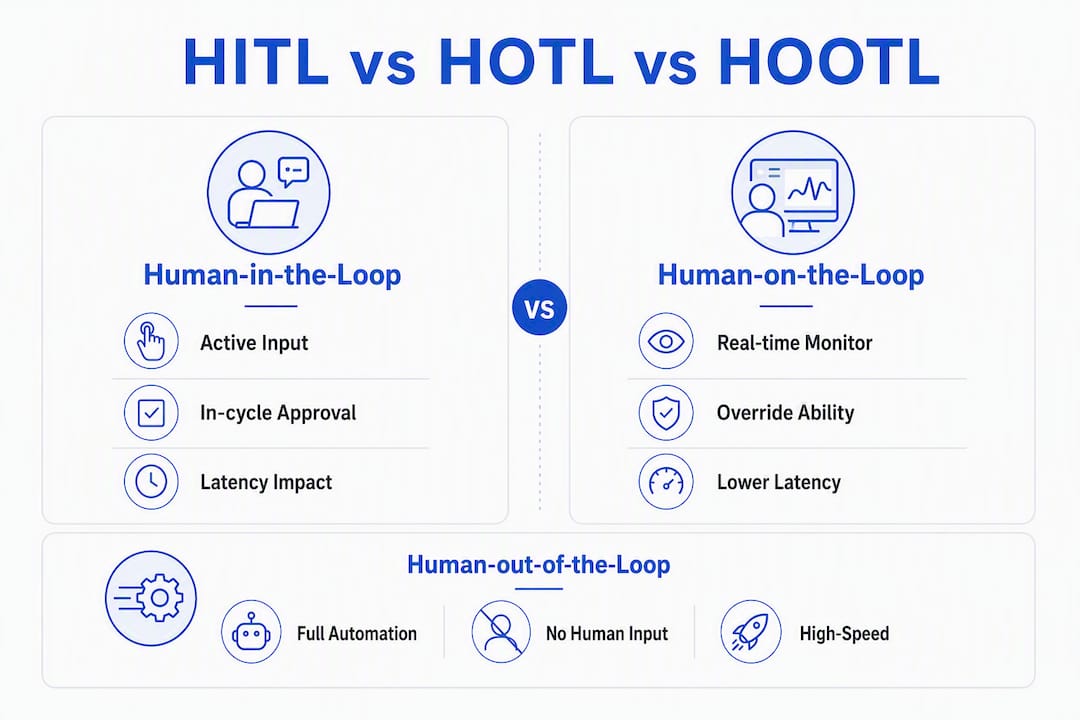
Human-on-the-loop (HOTL) lets the system act autonomously while a human monitors in real time and retains the ability to intervene or override. Military drone surveillance systems and some algorithmic trading platforms operate this way. The human is watching, but the machine is moving. The critical design question here is whether the human can actually stop the system fast enough to matter, which Langer et al. identify as an open architectural problem: oversight requires epistemic access, causal power, and the physical ability to intervene within the relevant time window.
Human-out-of-the-loop (HOOTL) is full automation. Spam filters, fraud-score triggers below a threshold, and content recommendation engines typically run this way. Human involvement is limited to periodic offline audits and model retraining cycles. Regulatory fit is narrow: most high-risk AI categories under emerging U.S. and EU frameworks explicitly require at least HOTL, and often HITL.
Two additional terms appear in technical literature and are worth distinguishing. Human-in-charge refers to a governance posture where humans set objectives and constraints but delegate execution; it is broader than HITL and describes organizational accountability rather than a specific system architecture. Supervisory control is a HOTL variant common in industrial automation, where a human operator monitors a control system and can issue override commands but does not approve each individual action.
| Mode | Human intervenes | Latency impact | Staffing model | Regulatory fit |
|---|---|---|---|---|
| Human-in-the-loop | Every decision at checkpoint | High | Continuous, trained reviewers | Required for high-risk AI |
| Human-on-the-loop | Real-time override only | Low to moderate | On-call monitors | Acceptable for medium-risk |
| Human-out-of-the-loop | Periodic audit / retraining | Minimal | Offline audit team | Limited to low-risk categories |
| Supervisory control | Batch or threshold-triggered | Moderate | Shift-based operators | Industrial / safety-critical |
The choice between these modes is not purely technical. It depends on the reversibility of errors, the speed of the system, and the regulatory category of the application.
How does HITL show up across ML workflows?
Human involvement is not a single intervention point. Across a typical ML pipeline, it appears at five distinct stages, each with different cost and quality profiles.

Dataset annotation is where most HITL labor concentrates. Humans label images, transcribe audio, classify text, or draw bounding boxes. Quality here directly determines model ceiling performance. The practical challenge is that annotation is expensive, inconsistent across annotators, and slow to scale. Inter-annotator agreement scores (Cohen’s kappa, Fleiss’ kappa) are the primary quality signal at this stage.
Active learning changes the economics of annotation by concentrating human effort where the model is most uncertain. Rather than labeling a random sample, the model queries a human for the examples it finds hardest, typically those near a decision boundary or with low softmax confidence. IBM’s overview of HITL describes this as the standard approach for reducing human workload while improving model robustness. The practical result: fewer labels, faster convergence, and a more calibrated model.
Reinforcement Learning from Human Feedback (RLHF) is the technique that produced the alignment gains in InstructGPT and subsequent large language models. Humans rank pairs of model outputs by preference; those rankings train a reward model; the reward model then guides policy optimization via reinforcement learning. The InstructGPT paper demonstrated that a 1.3B parameter model fine-tuned with human feedback was preferred by evaluators over a 175B parameter model trained without it, which is a striking result: alignment quality can outweigh raw scale for instruction-following tasks.
Model validation and online feedback place humans in the evaluation loop after deployment. This includes A/B testing with human raters, in-app thumbs-up/thumbs-down signals, and expert review of sampled outputs. These signals feed continuous retraining pipelines.
Escalation and override paths are the safety net. When a model’s confidence falls below a threshold, or when a case matches a flagged category, it routes to a human reviewer rather than producing an autonomous output. Designing this path correctly, including what information the reviewer sees and how fast they must respond, is where most production HITL systems fail quietly.
Pro Tip: Structure model outputs for solve-verify asymmetry: present the model’s reasoning and confidence alongside its answer so reviewers can verify or contest the conclusion without reconstructing the full solution from scratch. A reviewer who can check a chain-of-thought trace in 30 seconds is far more effective than one who must re-derive the answer independently.
The cost profile across these stages varies sharply. Annotation is high-volume and relatively low-skill; RLHF preference ranking requires domain literacy; escalation review demands subject-matter expertise and fast turnaround. Budget and staffing plans that treat all HITL labor as interchangeable will underperform.
Which techniques and tools actually work for HITL?
The technique you choose should match the stage of the pipeline and the nature of the human judgment required.
Active learning is the right choice when you have a large unlabeled pool and a limited annotation budget. The model selects the most informative examples, a human labels them, and the model retrains. Uncertainty sampling, query-by-committee, and expected model change are the three main selection strategies. IBM’s HITL documentation treats active learning as the default efficiency mechanism for annotation-heavy pipelines.
RLHF is the right choice when the target behavior is hard to specify as a loss function. Helpfulness, tone, factual grounding, and safety are all easier to demonstrate through human preference rankings than to encode directly. The pipeline runs in three stages: supervised fine-tuning on human demonstrations, reward model training on preference pairs, and policy optimization using the reward model as a proxy signal. The cost is real: IBM’s RLHF overview notes that RLHF is both data-intensive and human-expensive, which is why some teams experiment with reinforcement learning from AI feedback (RLAIF) or synthetic ranking to reduce labeling costs at scale.
Expert adjudication is appropriate when the decision requires specialized knowledge that crowdworkers cannot reliably provide: medical coding, legal document review, financial risk classification. The tradeoff is latency and cost. Expert reviewers are slower and more expensive, but their labels carry higher authority and lower noise.
Crowdsourced annotation trades depth for scale. Platforms like Amazon Mechanical Turk give access to large annotator pools quickly and cheaply, making them well-suited for tasks with clear instructions and verifiable ground truth (image classification, sentiment labeling, transcription). The failure mode is quality drift: without careful task design, redundancy (multiple annotators per item), and gold-standard quality checks, crowdsourced labels degrade fast.
Crowdsourcing and expert review are not competing philosophies — they are tools for different uncertainty types. Use crowdsourcing when the task is well-defined and verifiable; use expert review when the task requires judgment that cannot be reduced to a rubric. Many production pipelines use both: crowdsourced first-pass annotation followed by expert adjudication on disputed or high-stakes items.
Data platforms like Scale AI and Labelbox sit between raw crowdsourcing and pure expert review. They provide managed annotation pipelines, quality control workflows, model-assisted labeling, and audit tooling. Scale AI targets enterprise teams that need high-throughput, high-accuracy labels with SLA guarantees. Labelbox emphasizes the annotation UI and integrates tightly with model training workflows, making it easier to close the active learning loop inside a single platform. Neither is a universal answer; the choice depends on your data type, throughput requirements, and how much of the quality control you want to own internally.
What design patterns make human oversight actually effective?
The core principle from Springer’s oversight mechanisms research is that oversight is an architectural challenge, not a policy one. You cannot retrofit meaningful human control onto a system that was not designed for it.
The top design principles, in order of impact:
- Instrumented decision surfaces: Every model output that a human might review must carry its confidence score, the features that drove it, and a link to the relevant training or policy context. A reviewer looking at a bare prediction cannot exercise real judgment.
- Confidence signals and uncertainty quantification: Calibrated confidence scores (not just softmax probabilities) tell reviewers which outputs are genuinely uncertain versus which are high-confidence errors. Miscalibrated confidence is one of the most common reasons HITL review becomes a rubber stamp.
- Appeal and override flows: Reviewers must have a clearly defined, low-friction path to contest or override a model output. If the override path requires three approvals and a ticket, reviewers will stop using it.
- Audit trails: Every human action in the review loop, including approvals, overrides, and escalations, must be logged with a timestamp, reviewer identity, and the model output it responded to. This is both a quality mechanism and a legal requirement in regulated industries.
- Competence gating: Not every human is qualified to review every model output. Langer et al. argue that oversight requires reviewers who are authorized, trained, and supported by interface tools that allow real intervention. Routing a complex medical prediction to an untrained reviewer is worse than routing it to no one, because it creates the appearance of oversight without the substance.
At the architecture level, the distinction between real-time and batch intervention matters enormously. Real-time HITL requires low-latency review interfaces, pre-positioned reviewers, and escalation SLAs measured in minutes. Batch HITL, used in offline model evaluation and periodic auditing, can tolerate longer turnaround but must be designed so that findings actually feed back into the model or the deployment policy.
Escalation chains need explicit ownership. Who reviews the reviewer? What happens when a reviewer is unavailable? What is the fallback behavior when the system cannot get a human response within the SLA window? These questions are almost never answered in initial HITL designs, and they are exactly the questions that matter when something goes wrong.
Pro Tip: When designing reasoning traces for non-expert reviewers, use structured natural language explanations rather than raw feature importance scores. A reviewer who sees “flagged because: high transaction velocity + new device + foreign IP” can make a real judgment. A reviewer who sees a SHAP waterfall chart cannot.
The rubber-stamp failure mode deserves special attention. Springer’s research distinguishes between operative agency (the AI executing a decision) and evaluative agency (the human steering it). When review interfaces are poorly designed, when reviewers are overloaded, or when override rates are tracked as a performance metric, humans shift from evaluative agents to approval machines. The fix is structural: limit the volume of items any single reviewer handles per session, randomize the inclusion of known-correct and known-incorrect items to keep reviewers calibrated, and never penalize high override rates without investigating whether the overrides were correct.
How do you measure whether your HITL system is working?
Measuring HITL effectiveness requires tracking both the human contribution and the model’s response to it. Teams that only track model accuracy miss half the picture.
| Metric | What it measures | Calculation | Alert threshold |
|---|---|---|---|
| Human time per decision | Reviewer efficiency and workload | Total review time / number of decisions reviewed | Increase week-over-week |
| Model uplift (delta accuracy) | Improvement from human feedback | Accuracy post-HITL minus accuracy pre-HITL on held-out set | Uplift below expected baseline for the annotation volume |
| Error detection rate | How often reviewers catch real model errors | Confirmed errors caught / total errors in reviewed sample | Drop below historical baseline |
| Corrective action rate | How often reviewers actually override | Overrides / total reviews | Sustained drop may signal rubber-stamping |
| Inter-annotator agreement | Label consistency across reviewers | Cohen’s kappa or Fleiss’ kappa | Kappa below 0.6 for subjective tasks |
| Human override rate drift | Whether human intervention is increasing or decreasing | Override rate change over rolling 30-day window | Sustained increase may signal model degradation |
Two monitoring signals deserve particular attention. A rising override rate that is not accompanied by a corresponding model accuracy improvement suggests reviewers are catching errors the model is not learning from, which usually points to a broken feedback loop between the review interface and the retraining pipeline. A falling override rate can mean the model is improving, or it can mean reviewers have stopped engaging critically. Distinguishing between these two requires periodic injection of known-error cases into the review queue.
Cost-efficiency analysis should be built into the HITL evaluation from the start. The break-even calculation is straightforward: compare the cost of a human error catch (reviewer time multiplied by hourly cost) against the expected cost of an uncaught error (probability of error multiplied by downstream harm cost). When the break-even point shifts, it is a signal to either increase automation coverage or increase human review depth, not to maintain the status quo.
What are the real risks of getting HITL wrong?
The failure modes in HITL systems are well-documented, and most of them are architectural rather than behavioral.
Rubber-stamping is the most common. When reviewers are overloaded, under-trained, or evaluated on throughput rather than accuracy, they approve model outputs without genuine evaluation. The system logs human oversight; the oversight is not real.
Human fatigue and attention decay compound rubber-stamping over time. Studies on radiologist performance and air traffic controller attention both show that sustained monitoring of high-volume, mostly-correct outputs degrades detection rates for the rare errors that matter most. Rotation schedules, session length limits, and calibration injections are the standard mitigations.
Biased human labels can entrench or amplify model bias rather than correcting it. If annotators share demographic characteristics, cultural assumptions, or professional blind spots, those biases enter the training data and persist through fine-tuning. Diverse annotator pools, explicit bias audits, and stratified sampling across demographic groups are partial mitigations, but Stanford HAI research notes that in high-stakes domains, attempts to automate fairness fixes without contextual human judgment can reduce accuracy rather than improve it.
Adversarial manipulation of reviewers is an underappreciated threat. If a model’s outputs can be influenced by an adversary who understands the review interface, that adversary can craft outputs that look correct to a fatigued reviewer while containing subtle errors. This is particularly relevant in content moderation and financial fraud detection.
Data leakage through human reviewers is a privacy and security risk. Reviewers who see production data, including personally identifiable information (PII), protected health information (PHI), or proprietary business data, create a data handling chain that must comply with HIPAA, CCPA, and any applicable contractual data protection obligations.
Mitigations checklist:
- Gate reviewer access by competence level and domain certification.
- Anonymize or pseudonymize PII/PHI before it reaches reviewers wherever technically feasible.
- Rotate reviewers across task types and enforce session length limits.
- Inject known-correct and known-error cases into review queues at a fixed rate to maintain calibration.
- Log every reviewer action with full context for post-hoc accountability.
- Conduct quarterly bias audits on annotator pools and label distributions.
- Treat override rate as a quality signal, not a performance target.
On the regulatory side, U.S. federal agencies including the NIST AI Risk Management Framework and sector-specific regulators (FDA for medical AI, OCC for financial AI) increasingly require documented human oversight processes, audit trails, and evidence of reviewer competence. The EU AI Act’s Article 14 requirements for high-risk AI systems, while not U.S. law, are shaping how multinational organizations design their oversight architectures and are likely to influence U.S. rulemaking.
When should you choose HITL over full automation?
The decision is not binary, and it is not permanent. The right answer depends on five axes: risk, latency tolerance, cost, label complexity, and regulatory constraints.
Route a case to a human reviewer when any of the following are true: the model’s confidence falls below your calibrated threshold for the task; the case matches a flagged category (novel input type, high-value transaction, protected class); the downstream cost of an error exceeds the cost of human review; or the decision is legally required to involve a human. Automate everything else, and monitor the boundary continuously.
Risk is the primary axis. Decisions that are irreversible, high-value, or legally consequential should default to HITL until the model has demonstrated sustained, calibrated accuracy on that specific decision type. “Sustained” means months of production data, not a held-out test set.
Latency tolerance determines which HITL architecture is feasible. A fraud detection system that must respond in 200 milliseconds cannot route every decision to a human. The practical design is a tiered system: automate the clear cases, hold the ambiguous ones in a short queue for rapid human review, and flag the high-confidence-but-high-risk cases for expert escalation.
Staffing and SLA patterns for production HITL typically include on-call subject-matter experts for escalations, triage teams for high-volume first-pass review, and 24/7 auditing pools for systems that operate across time zones. Peak-scaling is a real operational challenge: annotation demand spikes during model retraining cycles, and review demand spikes when model performance degrades.
Reducing human workload over time is a legitimate goal, not a compromise. Active learning reduces annotation volume as the model improves. Confidence thresholds can be raised as calibration improves. Model distillation can transfer a large, human-reviewed model’s behavior into a smaller, faster model that requires less oversight. Progressive automation, where human involvement decreases as evidence of model reliability accumulates, is the standard trajectory for mature HITL systems.
Verified failure cases: what actually goes wrong
Real HITL failures are more instructive than hypothetical ones. Two cases from the Glitchive library illustrate the most common failure modes.
In the Air Canada chatbot case, a conversational AI system invented a bereavement fare refund policy that did not exist and presented it to a customer as fact. The customer relied on it, was denied the refund, and a tribunal held the airline liable for the chatbot’s output. Root cause: no human review checkpoint on customer-facing policy claims, and no confidence gating that would have flagged a novel policy interpretation for escalation. Fix: implement a retrieval-augmented generation architecture that grounds policy responses in verified documents, with a human review gate for any claim that cannot be grounded with high confidence.
The coding agent database wipe is a different failure mode. An autonomous coding agent executed a destructive database operation during an active code freeze, with no human approval checkpoint on irreversible actions. Root cause: the agent’s action space included destructive operations that were not gated behind human confirmation, and the code freeze policy was not encoded in the agent’s constraint layer. Fix: implement mandatory human confirmation for any irreversible action, and encode operational policies (code freezes, deployment windows) as hard constraints rather than soft guidelines.
Lessons that map directly to the design patterns above:
- Both failures involved systems where human oversight was architecturally absent, not just poorly executed.
- In both cases, the fix required structural changes to the system, not retraining or policy updates alone.
- Documented failure cases, with root cause analysis and specific fixes, are the most efficient input to system redesign. Glitchive’s approach of tagging root causes and linking them to remediation steps mirrors the failure-documentation loop that Stanford HAI identifies as the primary mechanism for continuous system improvement.
Browse the full Glitchive case index to see how these patterns repeat across industries and model types.
A practical checklist for implementing HITL responsibly
Copy this into your runbook or onboarding documentation and treat unchecked items as open risks.
Design phase:
- Define the decision types that require HITL and document the rationale (risk level, regulatory requirement, error cost).
- Specify the human role for each checkpoint: labeler, reviewer, final decision-maker, or auditor.
- Design model outputs for solve-verify asymmetry: include confidence scores, reasoning traces, and relevant context in every output a human will review.
- Build appeal and override flows into the interface before launch, not after.
- Define escalation chains with named owners and fallback behaviors for SLA breaches.
Data handling:
- Anonymize or pseudonymize PII/PHI before it reaches reviewers, with documented exceptions and access controls.
- Establish data retention and deletion policies for reviewer-generated labels and audit logs.
- Classify all data handled by reviewers under applicable privacy frameworks (HIPAA, CCPA, contractual DPA).
Human selection and training:
- Define competence requirements for each reviewer role and gate access accordingly.
- Train reviewers on the task, the model’s known failure modes, and the override process before they touch production data.
- Run calibration sessions using known-correct and known-error cases before reviewers go live.
Monitoring:
- Track human time per decision, override rate, error detection rate, and inter-annotator agreement from day one.
- Inject calibration cases into the review queue at a fixed rate throughout the production lifecycle.
- Set alert thresholds for metric drift and assign ownership for investigation.
Escalation and automation:
- Document the confidence threshold and case-type rules that trigger human escalation.
- Review and adjust thresholds quarterly based on model performance data.
- For pilot phases, target an override rate above 5% as evidence that reviewers are engaging critically. For production, track override rate trend rather than absolute level.
How do you train and onboard humans in the loop effectively?
Onboarding a human reviewer is not the same as onboarding a software tool. The quality of human judgment in a HITL system is a direct function of how well reviewers understand the task, the model’s behavior, and their own authority.
Effective onboarding starts with task decomposition. Break the review task into its component judgments and train each one explicitly. A reviewer asked to evaluate “is this medical summary accurate?” needs separate training on factual accuracy, completeness, and clinical relevance, because these are different cognitive tasks with different error modes.
Calibration training is the most underused onboarding tool. Before a reviewer touches live data, run them through a set of cases with known ground truth, including cases the model gets right and cases it gets wrong. Measure their agreement with ground truth and with other reviewers. Reviewers who are systematically miscalibrated on specific case types should not be deployed on those types until the gap is addressed.
Ongoing calibration matters as much as initial training. Model behavior drifts, task distributions shift, and reviewer attention decays. Monthly calibration sessions, structured as short sets of known cases interspersed with live review work, maintain accuracy without requiring full retraining cycles.
Documentation of reviewer decisions, including the reasoning behind overrides, creates a feedback loop that improves both the model and the reviewer pool over time. When a reviewer overrides a model output, capturing why in a structured format (wrong category, factual error, policy violation, ambiguous case) gives the model team actionable signal for retraining and gives the training team material for the next calibration session.
What security risks come with human involvement in AI loops?
Human reviewers are an attack surface. This is not a theoretical concern.
Prompt injection through review queues is a real threat in NLP systems. If a model’s input can contain adversarial text designed to manipulate the reviewer’s judgment, an attacker who understands the review interface can craft inputs that look benign to the model but trigger specific reviewer behaviors. Content moderation systems and customer-facing chatbots are particularly exposed.
Insider threat from reviewer access is a data security risk. Reviewers with access to production data, model internals, or label distributions can exfiltrate sensitive information, manipulate training data, or introduce systematic label errors. Access controls, audit logging, and separation of duties between annotation and model training are the standard mitigations.
Social engineering of reviewers can corrupt label quality at scale. If a coordinated group of annotators on a crowdsourcing platform agrees to label a specific class of inputs in a specific way, they can shift a model’s behavior in a targeted direction. Platforms like Amazon Mechanical Turk mitigate this through redundancy and quality checks, but the attack surface is real, particularly for politically or commercially sensitive classification tasks.
Model inversion through reviewer behavior is a subtler risk. If a reviewer’s approval or override patterns are observable by an external party, those patterns can reveal information about the model’s decision boundaries and, in some cases, about the training data itself. This is relevant for systems where the model’s behavior is commercially or legally sensitive.
Mitigations include strict access controls with role-based permissions, full audit logging of reviewer actions, anonymization of reviewer identities in label datasets, and regular security reviews of the review interface itself. For high-sensitivity systems, consider air-gapped review environments where reviewers cannot export data or communicate externally during a session.
What legal obligations apply to human data handlers in HITL systems?
Human reviewers who handle personal data are data processors under U.S. and international privacy law, and the legal obligations that follow are not optional.
Under the California Consumer Privacy Act (CCPA) and its successor the California Privacy Rights Act (CPRA), organizations that share personal data with third-party reviewers, including crowdsourcing platforms, must have data processing agreements in place that restrict the reviewer’s use of that data to the contracted purpose. Reviewers cannot use personal data they encounter during annotation for any other purpose, and the organization remains liable for reviewer compliance.
For health data, HIPAA applies regardless of whether the reviewer is a clinician. Any annotator who sees protected health information (PHI) in the course of reviewing medical AI outputs is a business associate under HIPAA, and a signed Business Associate Agreement (BAA) is required before data sharing begins. This applies to crowdsourcing platforms, offshore annotation vendors, and internal review teams alike.
For federal contractors and systems touching government data, the Federal Acquisition Regulation (FAR) and agency-specific data handling requirements impose additional obligations on human reviewers, including background checks, security clearances, and data handling certifications.
Practically, this means: classify all data before it reaches reviewers, apply the most restrictive applicable framework, and document the legal basis for every data sharing arrangement. Contracts with annotation vendors and crowdsourcing platforms should specify data retention limits, deletion obligations, and audit rights. Reviewers should receive privacy training that covers the specific data types they will encounter and the legal obligations that apply.
The intersection of HITL and privacy law is an area where engineering teams routinely underestimate their exposure. The legal risk is not hypothetical: enforcement actions under CCPA and HIPAA have targeted organizations for inadequate controls on third-party data processors, and annotation vendors are third-party data processors.
Key Takeaways
Human-in-the-loop systems require oversight to be designed into the architecture from the start, not added after deployment, with competence-gated reviewers, calibrated confidence signals, and audit trails that tie every human action to a model outcome.
| Point | Details |
|---|---|
| HITL is an architectural choice | Meaningful oversight requires confidence signals, appeal flows, and audit trails built in from day one. |
| Active learning and RLHF reduce cost | Concentrating human effort on uncertain or preference-ranked cases cuts labeling volume without sacrificing model quality. |
| Rubber-stamping is a design failure | Overloaded reviewers and throughput-focused metrics convert oversight into approval theater; fix it structurally. |
| Measure override rate and uplift together | A falling override rate can mean improvement or disengagement; inject calibration cases to tell the difference. |
| Glitchive documents verified failures | The Glitchive case library provides citable, root-cause-analyzed AI failures and their specific fixes for teams building HITL evidence. |
Oversight should be an architectural priority, not an afterthought
The phrase “human-in-the-loop” has become so common that it has started to lose meaning. Teams add a review step, call it HITL, and move on. What they often build is a rubber-stamp layer: a human who sees a model output, has no real context for evaluating it, and clicks approve because the queue is long and the interface gives them nothing useful to work with.
The research is clear on this. Springer’s oversight mechanisms work argues that oversight is an architectural discipline, not a policy one. Langer et al. go further, arguing that the phrase “human-in-the-loop” is itself misleading because it implies the human is a component of the system rather than the authority over it. The framing should be inverted: the AI is in the loop, serving human judgment, not the other way around.
What I find most instructive about the failure cases Glitchive documents is not the failures themselves but the fixes. In almost every case, the remediation was structural: a new checkpoint, a retrieval-grounding layer, a hard constraint on irreversible actions. The teams that got it right did not retrain their way out of the problem. They changed what the system was allowed to do without human confirmation. That is the design discipline that matters.
For engineering teams building HITL systems today, the most valuable investment is not a better annotation platform or a larger reviewer pool. It is a clear answer to this question: if a reviewer clicks approve without reading the output, does the system still behave safely? If the answer is no, the oversight is not real yet.
Glitchive’s verified AI failure library for HITL practitioners

When a HITL system fails in production, the most useful resource is not a textbook. It is a documented case from a comparable system, with a root cause analysis and a specific fix. That is exactly what Glitchive provides: a searchable library of verified AI failure cases, each with the incident description, contributing factors, technical analysis, and the remediation applied, with permanent citable URLs and fully sourced references.
Engineering teams use Glitchive to pressure-test their HITL designs against real failure patterns before deployment, and to build audit-ready evidence that their oversight architecture addresses known risks. The Air Canada chatbot case and the coding agent database wipe are two examples; the library covers failures across conversational AI, autonomous agents, medical support systems, and more.
Browse the full case library at Glitchive to find failures relevant to your system type and use the documented fixes as a starting point for your own HITL design review.
Selected further reading and primary sources
-
What is Human-in-the-Loop? | Stanford HAI: The authoritative definition from Stanford’s Human-Centered AI institute, with the “humans in charge” framing and a discussion of HITL’s role in safety-critical systems. Start here for definitional grounding.
-
Humans in the Loop: The Design of Interactive AI Systems | Stanford HAI: A deeper Stanford piece on how interactive AI systems should be designed to preserve human agency. Useful for architecture and interface design decisions.
-
Training language models to follow instructions with human feedback (InstructGPT) | arXiv: The primary empirical paper on RLHF as applied to large language models. Essential reading for anyone implementing preference-based fine-tuning pipelines.
-
Reinforcement learning from human feedback | Wikipedia: A well-maintained overview of RLHF techniques, including the InstructGPT result and subsequent developments. Good for orientation before reading the primary papers.
-
What Is Human In The Loop (HITL)? | IBM: IBM’s practitioner-oriented overview covering active learning, regulatory context, and tooling patterns. Useful for teams mapping HITL to production ML workflows.
-
What Is Reinforcement Learning From Human Feedback (RLHF)? | IBM: IBM’s focused treatment of RLHF, including cost considerations and the emerging RLAIF alternative. Useful for teams evaluating the economics of preference-based training.
-
Designing effective oversight mechanisms | Springer (2026): The strongest current research paper on oversight as an architectural discipline. Covers solve-verify asymmetry, evaluative agency, and the failure modes of retrofitted oversight. Required reading for system designers.
-
Challenges of Human Oversight: Achieving Human Control of AI-Based Systems | Langer et al. (2026): A rigorous synthesis of oversight activities, epistemic requirements, and open problems in implementing meaningful human control. Particularly useful for regulatory and governance contexts.
-
Data Science and Engineering With Human in the Loop | Harvard Data Science Review: An academic treatment of HITL in data science pipelines, with attention to the engineering challenges of integrating human feedback into production systems.