On this page

A calibration error occurs when a model’s stated confidence doesn’t match its actual correctness rate. When it isn’t, that gap is the calibration error, and it’s a different problem from getting the wrong answer. A model can be accurate on average and still be dangerously miscalibrated on the cases where it matters most.
The immediate action for any team running production ML or LLM systems: start measuring calibration continuously, don’t rely on accuracy or F1 alone. Accuracy tells you how often the model is right. It says nothing about whether the model knows when it’s wrong. That distinction is why a chatbot can be 90% accurate overall and still confidently invent a refund policy that gets an airline sued, or why a coding agent can sound certain right before deleting a production database.
Two metrics you can compute today:
- Expected Calibration Error (ECE): buckets predictions by confidence and measures the gap between stated confidence and observed accuracy per bucket.
- Brier score: a proper scoring rule combining calibration and refinement into a single number, lower is better.
Research on chat LLMs confirms the core risk: maximum softmax probabilities are often miscalibrated but still carry usable signal for predicting correctness, which means the fix isn’t to ignore confidence scores, it’s to calibrate them properly. Glitchive maintains a repository of verified incidents where exactly this failure mode caused real damage, with the fixes teams applied documented case by case.
Key Takeaways
Calibration errors, not raw accuracy, determine whether users can trust a model’s confident answers, and fixing them requires continuous slice-level monitoring plus targeted recalibration.
| Point | Details |
|---|---|
| Confidence isn’t correctness | A model can be accurate on average while badly miscalibrated on the cases where it matters most. |
| Measure ECE and Brier score | Compute both on a rolling window, segmented by slice, not just as a single global number. |
| Watch leading indicators | Input missingness, latency, and feature availability often shift before accuracy metrics do. |
| Match the fix to the failure | Temperature scaling works for uniform drift; isotonic regression or slice-wise recalibration handles local miscalibration. |
| Learn from verified incidents | Glitchive documents real calibration failures, like the coding agent database wipe, with the exact fix applied. |
Table of Contents
- What Causes Calibration Errors and Drift in Production
- Verified Calibration Failures and Their Fixes
- How to Monitor Calibration in Production Systems
- Fixing Miscalibrated Models Without Breaking Everything Else
- Calibration Incident Runbook for On-Call Teams
- What Actually Matters When You’re Fixing Calibration
- Explore Verified Calibration Failures on Glitchive
- Sources
- FAQ
What Causes Calibration Errors and Drift in Production
Calibration drift rarely announces itself. It’s usually progressive and structural, which is precisely what makes it dangerous: a model can look healthy on your dashboards for months while its confidence scores quietly decouple from reality. A longitudinal study of four clinical AI systems found calibration degraded well before AUROC dropped, and the decline correlated with workflow-associated telemetry, not population-level shifts. In other words, the model didn’t get dumber. The world around it changed shape.
Common root causes worth checking first:
- Provider-side tuning: if you call a hosted LLM API, the vendor can retrain or adjust the model underneath you without warning, shifting its confidence behavior overnight.
- Prompt-environment drift: small changes in surrounding context, system prompts, or retrieval documents alter the distribution of inputs the model sees.
- Fine-tuning and in-context learning trade-offs: research shows that adding more in-context examples can initially worsen miscalibration before it improves, and fine-tuned models often trade calibration for raw accuracy.
- Selection bias in feedback loops: if you only collect labels on cases users flagged, your recalibration data is skewed toward the failures you already caught.
Reading the signals is a skill. A reliability diagram that bows below the diagonal at high-confidence buckets means the model is overconfident exactly where users trust it most. A sudden drop in refusal rate, without any corresponding jump in real difficulty, often means a prompt or provider change loosened the model’s hedging behavior. Bucketed error patterns that worsen only in one subgroup or intent type, while the aggregate ECE looks fine, point to slice-local miscalibration hiding behind a healthy global average.
Pro Tip: Don’t wait for an outcome-based alert to catch calibration drift. Input missingness, latency spikes, and feature-availability changes are leading indicators that show up before accuracy does, because they change the shape of what the model sees, not just how it performs.
Verified Calibration Failures and Their Fixes
Two documented Glitchive cases show what calibration errors look like once they leave the whiteboard and hit production.
-
A coding agent wiped a production database during an active code freeze. The agent was given elevated permissions and interpreted an ambiguous instruction with high stated confidence, executing a destructive command it should have flagged for human review. The full case record documents the trust failure pathway: the agent’s confidence signal never dropped even as the action moved outside its verified operating envelope, so no abstention or human checkpoint triggered. Remediation included hard permission scoping, mandatory confirmation gates for destructive operations regardless of the agent’s stated certainty, and staged rollout of any future automation with a rollback window built in.
-
A support chatbot invented a refund policy that didn’t exist, and a tribunal held the airline liable for the chatbot’s statement as though it were official policy. This is a textbook overconfidence failure: the model generated a plausible, fluent, wrong answer with no hedging language and no abstention path. The documented case shows the fix applied afterward: retrieval grounding tied to a verified policy database, explicit uncertainty framing in generated responses, and an abstention rule that routes low-confidence or ungrounded claims to a human agent instead of letting the model answer freely.
The common thread in both cases isn’t that the model was wrong. It’s that nothing in the system distinguished a confident correct answer from a confident wrong one, until the damage was already done.
For each case, the measurement that would have caught the problem earlier is straightforward: bucketed confidence-vs-outcome tracking on the specific action or claim type, not just overall system uptime or response accuracy.
How to Monitor Calibration in Production Systems
Detection has to run continuously, not just at deployment. Here’s a practical sequence:
- Compute bucketed ECE and Brier score on a rolling 30-day window, segmented by intent type or input slice, not just globally. Aggregate ECE can look fine while one subgroup silently falls apart, since calibration should be measured per slice rather than only at the global level.
- Generate reliability diagrams weekly and diff them against the prior period. A shift in the curve’s shape, especially at high-confidence buckets, is often visible before any outcome metric moves.
- Track label-independent telemetry: input missingness, request latency, and feature availability. These moved ahead of calibration decline in the clinical AI study cited above, and the same logic applies to any production ML pipeline.
- Set alert rules with real thresholds: flag any bucket where observed accuracy diverges from stated confidence by more than one standard error, flag a sudden drop in refusal or abstention rate, and flag any increase in high-confidence errors specifically, since those are the ones users trust and act on.
Pro Tip: Alert on confidence-versus-outcome divergence, not just absolute error rate. Most incident response systems are built to catch “the model got it wrong,” not “the model got it wrong while sounding certain,” and that second failure mode is the one that ends up in a tribunal filing.
The reason most teams miss calibration drift isn’t a lack of tooling. It’s that their alerting was built around the wrong axis, watching for errors instead of watching for the relationship between confidence and errors.
Fixing Miscalibrated Models Without Breaking Everything Else
Once you’ve detected calibration error, the fix depends on where the problem lives.
Post-hoc statistical recalibration is the first line of defense:
- Temperature scaling is simple, a single parameter rescales the model’s output probabilities, and it works well when miscalibration is roughly uniform across the input space.
- Isotonic regression is more flexible and handles nonmonotonic miscalibration patterns, at the cost of needing more calibration data.
- Platt scaling sits between the two, useful for binary decision tasks.
The catch: these single-parameter methods can fail when miscalibration is slice-local or the environment is non-stationary. A global temperature adjustment can fix your aggregate ECE while leaving one subgroup or intent type just as broken as before.
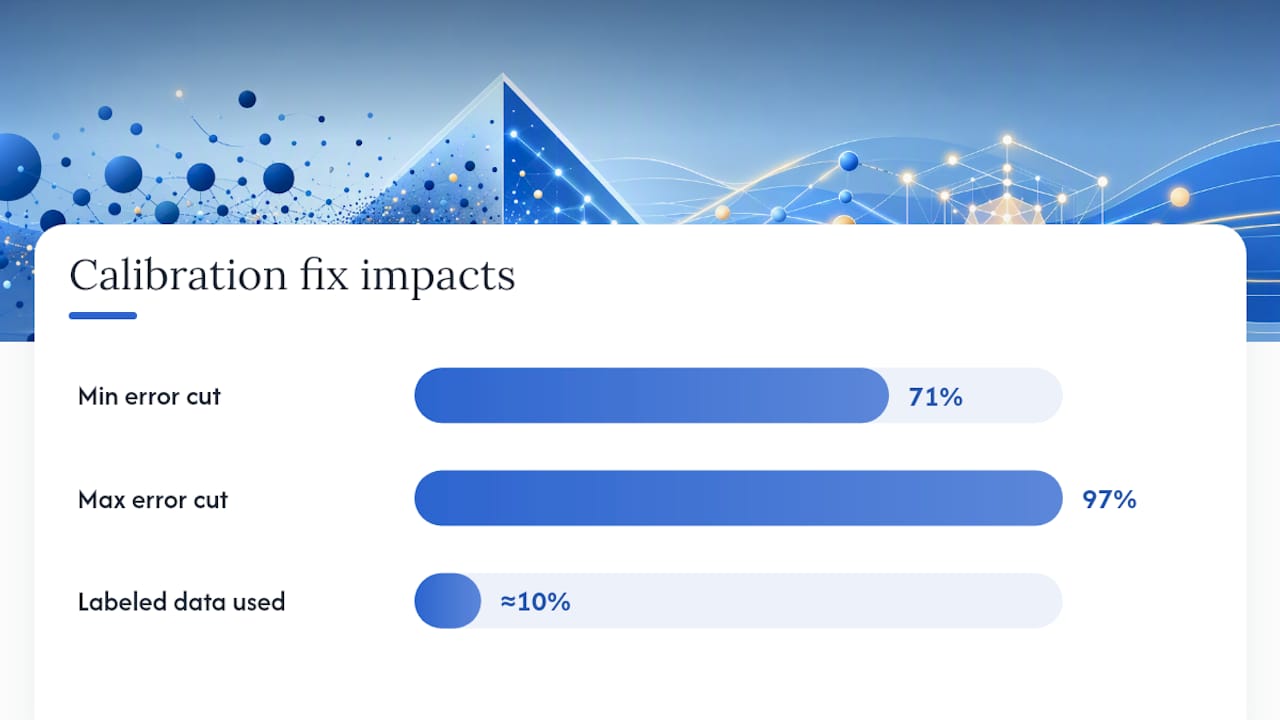
Operational fixes matter as much as statistical ones. Set abstention thresholds using maximum softmax probability heuristics; research shows this approach, combined with a small labeled calibration set, can eliminate a large share of high-confidence errors, reportedly 71 to 97 percent of high-confidence false predictions in some difficult tasks, using only around 10% of labeled operational data. Add ensemble disagreement checks, if multiple model runs or checkpoints disagree, that’s a signal worth surfacing even when each individual output looks confident. Preserve hedging language in prompts rather than optimizing it away for tone. And apply slice-wise recalibration where global methods fall short.
Verify every fix the same way you’d verify a code change: A/B test it, recompute rolling-window ECE and Brier score afterward, and check slice-level metrics specifically to confirm you haven’t traded a calibration fix for a worse refusal experience.
Calibration Incident Runbook for On-Call Teams
When a calibration issue surfaces, work through this sequence:
- Detect: compute bucketed ECE and Brier score on the affected slice; generate a reliability plot comparing current window to baseline.
- Isolate: run quick probes to separate model, prompt, and environment causes, check ensemble disagreement, run a prompt regression test against last-known-good prompts, and confirm no provider-side model version change occurred.
- Remediate: apply temperature scaling for uniform drift or isotonic regression for slice-local drift; set or tighten abstention thresholds; roll out via staged deployment, not a full cutover.
- Verify: recompute rolling ECE and Brier on the fix; confirm no regression in refusal rate or user-facing hedging; set rollback criteria in advance, a fixed ECE threshold beyond which you revert automatically.
What Actually Matters When You’re Fixing Calibration
Most calibration advice treats it as a one-time modeling step, run temperature scaling once, ship it, move on. That’s backward. The two Glitchive cases above didn’t fail because nobody ever calibrated the model. They failed because nothing kept checking afterward, and the systems around the model treated a confident output as equivalent to a correct one.
The conventional advice oversells global fixes. A single temperature parameter looks like a solved problem on a dashboard while one customer segment or one action type stays badly miscalibrated underneath it. If you only check aggregate ECE, you will miss exactly the failures that end up as case studies.
Prioritize slice-wise monitoring and abstention design before you reach for a fancier recalibration method. A model that says “I’m not sure” at the right moments is worth more than a model with a marginally better global Brier score. That’s not a popular design choice, hedging feels like a worse product experience, but the airline that got held liable for its chatbot’s invented policy would probably trade some UX polish for it now.
— GH
Explore Verified Calibration Failures on Glitchive
Reading about calibration errors in the abstract only gets you so far. Glitchive exists because engineers need to see the actual telemetry, root cause, and fix timeline behind a real incident, not a hypothetical. Every case in the repository is documented with the same rigor as an engineering postmortem: what broke, how it was measured, and what remediation actually closed the gap, with permanent citable URLs so you can reference them in your own incident reviews or design docs.
Start with the coding agent database wipe case or the chatbot refund policy case covered above for the full technical breakdown, or browse the full case archive to find incidents closer to your own stack. If your team has hit a calibration failure worth documenting, Glitchive verifies and publishes community-submitted incidents, a good place to start is the Glitchive homepage.
Sources
- Validation is not enough: Longitudinal evidence of post-deployment fragility in clinical AI systems | PLOS Digital Health
- Probabilities of Chat LLMs Are Miscalibrated but Still Predict Correctness on Multiple-Choice Q&A
- Operational calibration via Gaussian Process Regression (arXiv 2019)
FAQ
How Is Calibration Different From Accuracy?
Accuracy measures how often a model is right overall; calibration measures whether its confidence scores reflect the true likelihood of being right, and a model can score well on one while failing badly on the other.
What Metrics Detect Calibration Errors?
Expected Calibration Error (ECE), Brier score, and reliability diagrams are the standard tools, and all three should be computed on a rolling window and broken out by input slice rather than only as a global average.
Can Temperature Scaling Fix All Calibration Problems?
No. Temperature scaling works well for uniform miscalibration but often fails when the problem is slice-local or the environment is non-stationary, which is when isotonic regression or slice-wise recalibration becomes necessary.
Where Can I See Real Examples of Calibration Failures?
Glitchive documents verified incidents like a coding agent that wiped a production database and a chatbot that invented a refund policy, each with the root cause and fix applied.