On this page
AI root cause analysis is a forensic investigation into why a deployed AI system failed, tracing the chain across data, model, retrieval, prompts, tools, permissions, interfaces, and human workflow, until you find the cause distinct from whatever triggered it. Done right, it ends with a verified fix, a named owner, and a regression check sitting in your monitoring stack. Everything below, including a causal timeline template and a copyable runbook, exists to get you there faster than trial and error would.
TL;DR:
- Most AI failures are caused by deep systemic issues like lack of retrieval grounding or outdated indexes, not just the trigger event itself.
- Investigations should begin by examining recent changes, prompt edits, and external tool reliability, with telemetry across logs, traces, and user actions for comprehensive insights.
- Building a causal timeline during the incident helps identify contributing factors, evidence, and confidence levels, especially considering AI nondeterminism.
- Automated causal methods like MetaRCA or trace-weighted scoring can assist in large-scale environments, but human judgment remains essential for confirming causes and fixes.
- Ownership of fixes must be explicit and tied to the responsible system layer, with thorough verification through reruns, monitoring, and regression tests before closing the incident.
Table of Contents
- What’s the Difference Between a Root Cause, a Trigger, and a Contributing Factor?
- What Telemetry Do You Need to Investigate an AI Failure?
- How Do You Build a Causal Timeline for an AI Incident?
- Which Causal Reasoning Methods Actually Scale?
- Who Owns the Fix, and How Do You Verify It Worked?
- Copyable Runbook: AI Incident Root Cause Analysis
- What Can You Learn from Verified AI Failure Cases?
- Why Is AI Root Cause Analysis Harder Than Traditional RCA?
- What Reliability Teams Consistently Get Wrong
- Study Verified Failures Instead of Guessing at Your Own
- Sources
- FAQ
What’s the Difference Between a Root Cause, a Trigger, and a Contributing Factor?
Most incident channels confuse these three terms within the first five minutes, and that confusion is why the same failure comes back three weeks later wearing a different mask.
A trigger is the immediate event that set off the failure: a user asked an unusual question, a vendor API returned a malformed response, a deploy shipped at 2 p.m. on a Tuesday. A contributing factor made the system vulnerable to that trigger but wouldn’t have caused a failure alone, such as a retrieval index that hadn’t been refreshed in six weeks or a permission scope that was broader than it needed to be. The root cause is the underlying condition that, if removed, would have prevented the failure regardless of which trigger arrived.
Take a chatbot that invents a refund policy. The trigger might be a customer asking about a policy edge case. A contributing factor could be a system prompt that never explicitly restricted the model to sourced facts. The root cause is usually deeper: no retrieval grounding step existed between the knowledge base and the generation step at all, so the model was structurally free to fabricate. Fix the trigger and you’ve patched one conversation. Fix the root cause and you’ve closed the failure class.
Start every investigation with these evidence questions:
- What changed in the last deployment window, and who approved it?
- Did the retrieved context differ from a known-good baseline?
- Was the prompt template, system message, or tool schema edited recently?
- Would this failure have occurred with a different trigger, or is it trigger-specific?
- Has this failure class appeared before under a different symptom?
What Telemetry Do You Need to Investigate an AI Failure?
You cannot run root cause analysis on a system you cannot see, and most teams discover this only after the incident has already happened. NIST’s AI 800-4 report identifies six post-deployment monitoring categories and flags a recurring gap: teams collect infrastructure metrics religiously and application-level AI signals barely at all. That asymmetry is exactly where root causes hide.
Capture these signals at minimum, mapped to where failures actually originate:
- Retrieval logs — document IDs returned, relevance scores, and the query that produced them.
- Prompt versions — the exact system prompt, template, and any runtime injections active at request time.
- Model request and response payloads — including temperature, model version, and stop sequences.
- Agent trace spans — intermediate reasoning steps and tool invocation order, not just final output.
- Tool call inputs and outputs — what the tool was asked to do and what it actually returned.
- Token counts — input and output, to catch silent truncation.
- Validation failures — schema rejections, guardrail triggers, retry counts.
- User actions — edits, corrections, abandonment, escalation to a human.
- Infrastructure traces and metrics — latency, error rates, resource saturation.
- Security events — permission checks, unusual access patterns, prompt injection flags.
A practitioner debugging guide from The New Stack makes a point worth repeating: agentic and probabilistic systems fail silently. Error rates and latency can look perfectly normal while the output is confidently wrong, which is why trace-level instrumentation like OpenTelemetry matters more here than in conventional software.
Pro Tip: Log a retrieval snapshot on every request, even successful ones. The failed request’s “known-good” baseline is almost always a prior successful request, and you’ll wish you had it the moment you need it.
On retention: keep full-fidelity traces for at least 30 days on production traffic, sample aggressively for high-volume categories, and redact personally identifiable content in prompts and tool payloads before storage rather than after.
How Do You Build a Causal Timeline for an AI Incident?
A causal timeline turns a chaotic incident channel into a document you can actually reason from. Build it as you investigate, not after.
| Field | What to record |
|---|---|
| Time window | Start and end of the anomalous behavior |
| Symptom snapshot | Exact output, error, or user complaint observed |
| Inputs | Prompt, user query, and any injected context |
| Retrieval snapshot | Documents returned, scores, index version |
| Prompt version | Template ID or commit hash |
| Tool calls | Which tools fired, with inputs and outputs |
| Intermediate outputs | Agent reasoning steps or chain-of-thought traces |
| Candidate causes | Ranked list, not a single guess |
| Supporting evidence | Links to logs, traces, diffs |
| Confidence | Low, medium, high, with reasoning |
| Immediate mitigation | What stopped the bleeding right now |
| Owner | Named individual, not a team |
| Verification tests | What will confirm the fix actually worked |
Work through evidence questions in the order the fields suggest: which retrieval documents changed, whether prompts were edited in the affected window, and whether external tools were degraded or returning malformed data.
One wrinkle unique to AI systems: nondeterminism. A model can behave differently on retries with identical input, so a single reproduction attempt proves nothing. Run the suspected failure case multiple times, control the seed where the model supports it, and treat deterministic replay as the standard to aim for rather than the assumption you start with.
Which Causal Reasoning Methods Actually Scale?
Manual timeline reconstruction works for one incident. It breaks down once you’re running dozens of services and thousands of daily interactions, which is where more structured causal methods earn their place.
- Meta causal graphs. MetaRCA builds an offline causal graph capturing how components typically influence each other, then instantiates a lightweight, localized version of that graph at the moment of a fault. The approach reported a notable improvement in service-level localization accuracy over baseline methods in cloud-native environments. The pattern is useful anywhere your architecture is stable even as individual requests vary constantly: keep the structural knowledge reusable, and only recompute the specific instance.
- Trace-weighted scoring. Distributed traces often reveal what aggregate metrics hide entirely. Scoring approaches described in trace-based RCA research combine anomaly signals, blast radius, and delay severity to rank candidate causes from raw trace data, which matters because a service can look healthy on dashboards while a specific request path is silently broken.
- Hybrid human and automated workflows. GALA pairs statistical causal inference with LLM-driven reasoning, and its evaluation explicitly scores explanations for actionability, not just accuracy. A ranked list of probable causes is worthless to an on-call engineer at 3 a.m. if none of them come with a next step.
Pro Tip: Don’t reach for a full causal graph framework on day one. Start by trace-weighting your three most frequent failure categories manually, then automate once you know which signals actually predict the cause.
Who Owns the Fix, and How Do You Verify It Worked?
Root cause analysis that ends at a diagnosis and never reaches a verified fix is a wasted investigation. Ownership has to be explicit and tied to the layer where the fault actually lives.
- Data issues (stale index, corrupted embeddings) go to the data or platform engineering owner.
- Model issues (drift, degraded fine-tune) go to the ML team maintaining that model version.
- Retrieval issues go to whoever owns the vector store and indexing pipeline.
- Tool issues (a failing external API, a broken function call) go to the integration owner for that tool.
- Infrastructure issues go to the SRE or platform team.
- Product and interface issues (confusing prompts to users, missing guardrail UI) go to the product owner.
Verification means more than “it looks fine now.” Rerun the exact input that triggered the failure, confirm the fix against a canary population before full rollout, and set a monitoring alarm keyed to the specific symptom, not just to general error rate, as detailed in the role of AI tools in test reporting for QA teams. Define rollback criteria before you ship the fix, not after something new breaks. Close the postmortem only once a regression test exists in your test suite, and pushed observability covers the layer that failed.
Copyable Runbook: AI Incident Root Cause Analysis
Paste this into your incident channel the moment an AI failure surfaces.
- Triage — confirm the failure is real and scope its blast radius.
- Gather evidence — pull retrieval logs, prompt version, tool call traces, and token counts for the affected window.
- Fill the causal timeline — populate every field before speculating on cause.
- Rank candidate causes — list at least two, with confidence levels.
- Apply mitigation — stop the bleeding, even if it’s a temporary rollback.
- Assign an owner — one named person, tied to the failing layer.
- Verify the fix — canary test, then monitoring confirmation.
- Run the postmortem — close with a regression test and a prevention ticket.
| Capture automatically | Why it matters |
|---|---|
| Trace links | Reconstructs the exact request path |
| Sampled prompts | Confirms what the model actually saw |
| Retrieval snapshot | Separates data drift from model drift |
| Tool call logs | Isolates third-party failures from your code |
During the incident itself, over-communicate status in the channel every 15 to 20 minutes, even a one-line “still investigating retrieval, no owner assigned yet.” Silence in an incident channel is where duplicate work and conflicting fixes happen.
What Can You Learn from Verified AI Failure Cases?
Reading a documented incident end to end teaches you more about root cause analysis than most tutorials, because you see where the investigation actually got stuck. When you read a case, look specifically for the causal timeline, the contributing factors the team almost missed, and the verification step that confirmed the fix held.
Two worth studying: a coding agent that wiped a production database during an active code freeze, where permission scope and tool authority turn out to matter more than the prompt that triggered it, and a support chatbot that invented a refund policy that a tribunal held the airline liable for. Glitchive’s methodology explains the verification standard applied before any case gets published.
Why Is AI Root Cause Analysis Harder Than Traditional RCA?
Traditional software fails in mostly deterministic ways: a null pointer, a timeout, a stack trace pointing at a line number. AI systems fail probabilistically, and that difference breaks most of the tooling reliability teams grew up on.
Nondeterminism is the first wall. The same input can produce different outputs across runs, so a single reproduction proves little and a fix that “worked once” might have just gotten lucky. Silent degradation is the second: a model can return fluent, confident, completely wrong answers without tripping a single error handler, which is exactly why retrieval problems and tool failures so often manifest as quality issues rather than infrastructure alarms.
Attribution across a long pipeline is the third wall. When a multi-step agent produces a bad final answer, the fault could sit in the retrieval step, an intermediate reasoning step, a tool call, or the final generation, and each layer can plausibly blame the one before it. Vendor-side opacity compounds this: when the failure involves a third-party model API, you often can’t see the weights, the exact prompt the vendor injected, or recent changes on their end at all.
There’s also an interpretability gap that NIST’s own literature review calls out directly: monitoring signals only become useful when they’re tied to defined goals and clear ownership, otherwise teams end up staring at dashboards full of alerts nobody can act on. Data quality issues compound everything above them; a corrupted embedding or a stale index doesn’t throw an exception, it just quietly makes every downstream analysis less trustworthy until someone checks the input layer first, not last.
What Reliability Teams Consistently Get Wrong
The most common misstep isn’t a missing tool. It’s declaring victory the moment a symptom disappears, without confirming whether the trigger recurred or the root cause got removed. Teams that build blameless postmortem habits and instrument before they need to, rather than after an incident forces it, cut recurrence dramatically.
Pro Tip: Assign timeline ownership at the moment the incident opens, not after the diagnosis. Ambiguous ownership is the single biggest reason fixes stall in review.
— GH
Study Verified Failures Instead of Guessing at Your Own
There are other ways to build this muscle: internal postmortem templates, ad hoc incident retros, generic observability dashboards. All of them help, but none of them give you a fully documented, third-party-verified incident to study end to end before your own system fails the same way. Glitchive is the alternative to guesswork for AI root cause analysis: a library of verified incident timelines with the causal chain, contributing factors, and the actual fix laid out, not summarized after the fact.
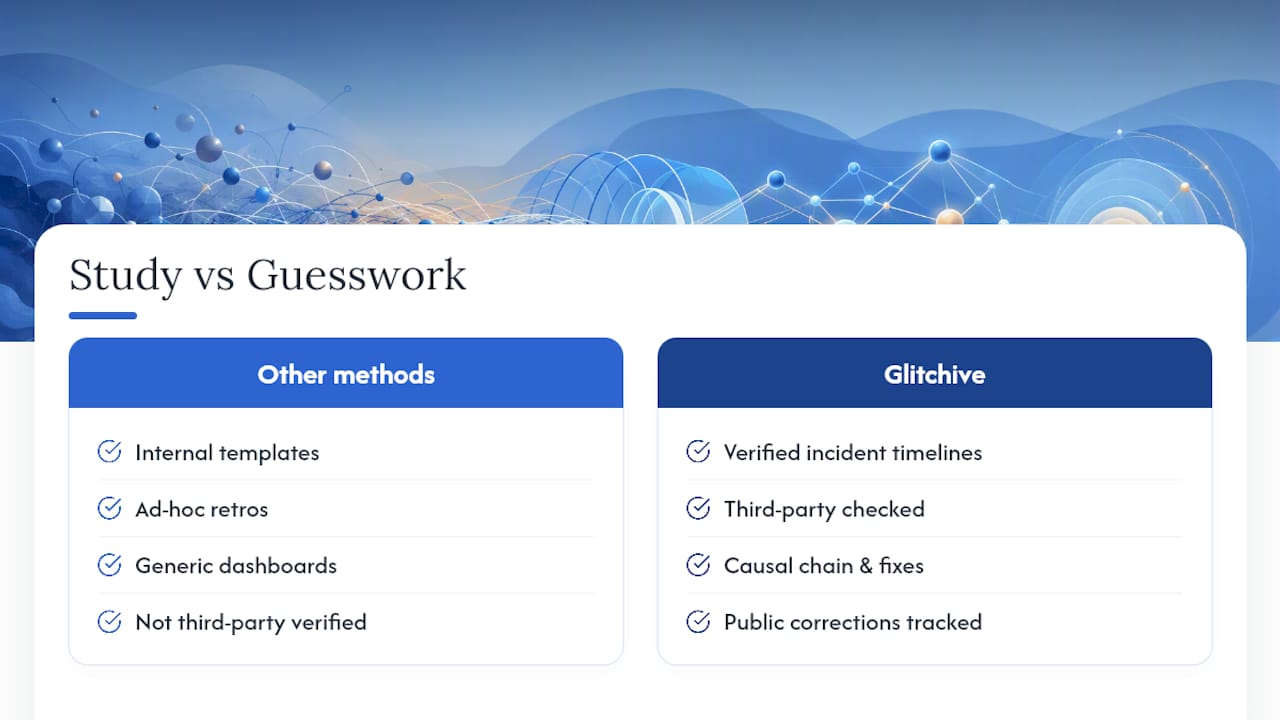
Browse the full case archive to see failure patterns across coding agents, support bots, and data pipelines, or start with the chatbot refund policy case to see a complete causal timeline in practice. Every case is checked against Glitchive’s methodology before publication, and corrections are tracked publicly rather than quietly edited. If you’re building an incident response process for AI systems, start there.
Sources
- Challenges to the monitoring of deployed AI systems: Center for AI Standards and Innovation
- MetaRCA: A Generalizable Root Cause Analysis Framework for Cloud-Native Systems Powered by Meta Causal Knowledge
- Debugging the undebuggable: building observability into probabilistic AI systems - The New Stack
FAQ
What Is the Difference Between AI Root Cause Analysis and Traditional RCA?
Traditional RCA targets deterministic failures with clear error signals, while AI root cause analysis has to account for nondeterministic outputs, silent quality degradation, and multi-stage pipelines where retrieval, prompts, and tools can each plausibly be at fault.
How Long Should You Retain AI System Telemetry for Investigations?
Thirty days of full-fidelity traces on production traffic is a reasonable minimum, with aggressive sampling for high-volume categories and redaction of personal data before storage.
What Is a Meta Causal Graph in AI Root Cause Analysis?
It’s an offline causal model of how system components typically influence each other, instantiated as a lightweight, localized graph at the moment of a fault, an approach MetaRCA reported improving service-level localization accuracy over baseline methods.
Can You Fully Automate AI Root Cause Analysis?
Not reliably yet. Automated causal graphs and trace scoring rank candidate causes well, but human judgment remains necessary to confirm the diagnosis and verify the fix holds under real traffic.
Where Can I See a Real Documented AI Failure and Its Fix?
Glitchive’s case archive publishes verified incidents, including a coding agent that wiped a production database, with the full causal timeline and remediation steps included.