On this page

AI risk management software, in the sense that matters for teams shipping LLM systems, means an evidence-first repository of verified AI failure case studies. Each entry documents an incident, its contributing factors, and the specific fix engineers applied, with a citable permalink and sourced references. If you’re evaluating one of these tools, or auditing whatever your team already uses, apply the scorecard below before you sign anything or trust anything.
Two checks matter more than the rest, and you can run them in the next ten minutes:
- Evidence provenance: does every case carry a permanent, citable URL and a documented fix, or just a vague description of “an incident”?
- API and exportability: can you pull a case record programmatically and get it into your own tracking system, or are you stuck copying text into a wiki?
If a vendor or internal tool fails both, stop the evaluation there. Everything else on the scorecard is refinement.
Key Takeaways
Evidence provenance, not catalog size, is the single strongest predictor of whether an AI failure repository will actually improve how your team ships and monitors systems.
| Point | Details |
|---|---|
| Definition matters | AI risk management software here means a verified case repository, not a governance dashboard. |
| Score provenance first | A missing citable URL or remediation step is an automatic disqualifier, not a minor deduction. |
| Test, don’t read | Fetch a case via API and export it before trusting any vendor’s description of its own catalog. |
| Weight by stakes | Safety-critical systems should weight evidence provenance and control mapping at 3x baseline. |
| Glitchive as reference | Glitchive’s case pages document provenance, TEVV-style fixes, and a public corrections process. |
Table of Contents
- What This AI Risk Management Software Scorecard Covers
- The Nine Scoring Criteria, With Pass/Fail Tests
- How to Run This Scorecard in a Real Evaluation
- What a Complete Case Record Actually Looks Like
- How to Evaluate AI Risk Management Software: A Vendor-Neutral Take
- See the Scorecard Applied to Real Cases
- Primary Sources Behind This Scorecard
- Sources
- FAQ
What This AI Risk Management Software Scorecard Covers
This scorecard evaluates repositories of documented AI failure cases, not enterprise governance suites with policy workflows and compliance dashboards. Those are a different product category solving a different problem. What you’re scoring here is narrower and more concrete: does the evidence exist, is it verifiable, and can your team act on it?
Two groups use this scorecard for different reasons. Builders (SREs, ML engineers, product managers) use it to decide whether a case repository will actually inform their testing and monitoring work. Buyers (procurement, risk engineers, engineering leadership) use it to justify a purchase or renewal with something more rigorous than a sales deck.
The scoring model breaks into criterion blocks, each rated 0 to 5:
- Assign each of the nine criteria below a raw score from 0 (absent) to 5 (fully documented and testable).
- Weight evidence provenance and eval integration at 2x the other criteria. These two predict whether the rest of the tool is trustworthy.
- Sum the weighted scores. Anything under 60% of the maximum total is a red flag, not a borderline pass.
- Treat a single 0 on evidence provenance as an automatic disqualifier, regardless of the total score.
Pro Tip: Run the scorecard against three cases picked at random by you, not three cases the vendor recommends. Cherry-picked demo cases hide gaps in the weaker parts of the catalog.
The Nine Scoring Criteria, With Pass/Fail Tests
Score each criterion by running an actual test, not by reading marketing copy. Here’s what to check and what a failing answer looks like.
1. Use-case inventory. Ask for a list of covered failure categories (hallucination, prompt injection, data leakage, agentic tool misuse, output validation failures). A pass means the catalog spans multiple categories with more than a handful of cases each. A fail means everything clusters around one narrow scenario, like chatbot tone issues, with nothing on destructive agent actions or structured-output failures.
2. Risk registers. Check whether each case links back to a named risk category and severity rating. Pass: consistent tagging you can filter on. Fail: free-text descriptions with no taxonomy.
3. Control mapping. Does the case connect its fix to a specific control, such as schema validation, human-in-the-loop review, or rate limiting? A repository documenting a three-layer SQL validation pipeline that greatly reduced hallucinated-query incidents is mapping control to outcome. A repository that just says “we fixed it” is not.
4. Evidence provenance. Request the raw case record. It should include an incident summary, root cause, contributing factors, remediation steps, a citable permalink, and any supporting artifacts (logs, code diffs, test additions). Score 0 if the source is anonymous or the case has no timestamp.
5. Eval integration (TEVV). The NIST AI Risk Management Framework treats measurement as a repeatable process: test, evaluate, verify, validate. A repository scores well here if cases reference regression tests or before/after metrics, like the a substantial reduction in invalid-JSON error rates documented in one guardrail postmortem. It scores poorly if fixes are described narratively with no measurement attached.
6. Monitoring and incident linkage. Does the case reference the metrics or alerts that surfaced the problem in production? A vLLM inference postmortem that ties a latency spike during a high-traffic sales event to specific block-manager metrics is the standard to hold vendors to.
7. Access controls and audit trail. For an internal tool, confirm that edits to a case record generate a timestamped change log with an author. For a vendor repository, ask who can submit corrections and how disputes get resolved.
8. APIs and exportability. Fetch one case via API and export it to JSON or CSV. If there’s no API, that’s not a minor gap. It means every downstream integration, from your test suite to your incident tracker, requires manual copy paste.
9. Vendor lock-in. Check the export format’s openness. If the only export is a proprietary format with no schema documentation, you’re locked in no matter how good the content looks.
- Missing remediation steps on more than a few cases signals a marketing catalog, not an evidence repository.
- No incident timestamps means you can’t correlate the case against your own logs or a public disclosure timeline.
- No API or export path means the “software” part of “AI risk management software” doesn’t really exist.
How to Run This Scorecard in a Real Evaluation
Procurement and engineering teams need different scripts, but they run against the same nine criteria.
For an RFI or RFP, add scorecard-derived line items directly into the document:
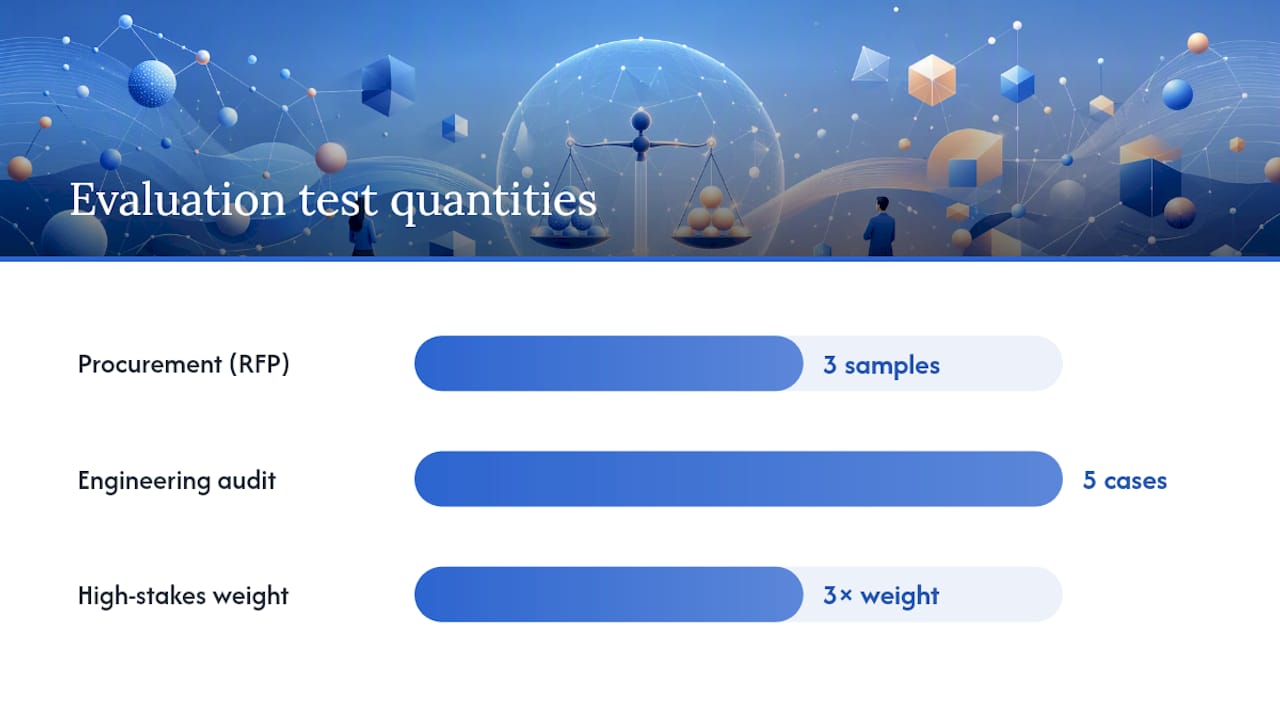
- Request three sample case records via API or export, not screenshots.
- Require a written answer on how corrections and disputes are handled, referencing an access-control policy if one exists.
- Ask for the underlying taxonomy behind the risk register, and check it against your own incident categories.
For an engineering audit of a repository you already use, or are considering adopting internally, build a short automated test:
- Script an API fetch of five cases and verify every required field returns non-null data.
- Export those five cases and confirm the file opens cleanly and preserves every field.
- Cross-reference one case’s remediation against your own TEVV artifacts (do you have an equivalent regression test?) and flag the gap if you don’t.
Weighting shifts by system stakes. Internal tooling with low blast radius can weight use-case coverage and API access more heavily instead, since speed of integration matters more than legal defensibility.
| Workflow | First action |
|---|---|
| Procurement | Add API/export request to the RFP before the demo call |
| Engineering audit | Script the five-case fetch and export test this week |
| High-stakes systems | Triple the weight on evidence provenance and control mapping |
What a Complete Case Record Actually Looks Like
Two documented incidents show what “complete” means in practice. Both are drawn from Glitchive’s case archive.

The chatbot invented refund policy case shows an airline support bot fabricating a bereavement fare policy that didn’t exist, with a small-claims tribunal later holding the airline liable for the bot’s statement. The complete record needs the exact prompt context, the tribunal’s finding, and the specific guardrail (grounding responses to a verified policy document) that closes the gap. That combination is what turns a cautionary anecdote into something your legal and product teams can act on.
The coding agent that wiped a production database during an active code freeze needs a different evidence set: command logs showing the destructive action, the rollback procedure, and the regression test added afterward to block agent-issued DML during freeze windows.
- Case 1 tests your evidence-provenance and control-mapping criteria directly.
- Case 2 tests monitoring/incident linkage and TEVV, since the fix lives in a specific added test, not a policy statement.
A repository publishing incidents like these with permanent URLs and named remediation steps is doing the opposite of a vague “AI can make mistakes” disclaimer. It’s giving you something to test against.
How to Evaluate AI Risk Management Software: A Vendor-Neutral Take
Most advice on evaluating this category focuses on breadth: how many cases, how many industries, how fresh the catalog looks. That’s the wrong first filter. A repository with 50 deeply documented cases, each with a real fix and a citable source, beats one with 500 thin summaries every time. Depth of evidence predicts usefulness; volume does not.
The bigger blind spot is treating these tools as reading material instead of test fixtures. A case study you can’t pull via API, diff against your own incident logs, or cite in a postmortem is trivia, not risk management software. The NIST AI RMF’s whole premise is that measurement has to feed management decisions. A repository that can’t be queried and cross-referenced breaks that link before it starts.
If you take one thing from this scorecard, make it evidence provenance. Everything else is refinement on top of a record you can actually trust.
See the Scorecard Applied to Real Cases
Glitchive built its case archive around exactly the criteria this scorecard tests for. Every incident includes a citable permalink, a documented root cause, and the specific remediation engineers implemented, whether that’s a guardrail, a regression test, or a rollback procedure. That’s not a claim about the category in general; it’s what you’ll find if you run the API fetch and export tests from Section 3 against Glitchive’s own cases library.
Where this matters most is the two checks flagged at the top: provenance and exportability. Both linked case studies above carry sourced references rather than anonymous write-ups, and Glitchive maintains a public corrections process for disputed details, which covers the access-control and audit-trail criterion directly. If you’re building your own scorecard evaluation, start by inspecting a handful of cases on Glitchive’s home page and running the fetch/export test yourself before you extend the same test to any other vendor.
Primary Sources Behind This Scorecard
- NIST AI Risk Management Framework for TEVV and measurement requirements.
- Billing system postmortem and SQL hallucination postmortem as practical fix documentation.
- NIST RMF explained for security teams for operationalizing the framework in procurement.
Sources
- NIST AI Risk Management Framework (NIST AI RMF)
- Postmortem: How LLM context window limits caused a critical bug in our billing system
FAQ
What Makes a Case Record “Verified” Rather Than Anecdotal?
A verified case includes a citable permalink, a documented root cause, and named remediation steps, ideally backed by a primary source like a postmortem or a court finding rather than an anonymous forum post.
Do I Need a Different Scorecard for Internal Tooling vs. Vendor Products?
No, the same nine criteria apply. Only the weighting changes: internal tools can weight API access and use-case coverage more heavily, while vendor products evaluated for high-stakes systems should weight evidence provenance and control mapping harder.
How Does AI Improve Risk Management if the Software Is Just a Case Archive?
A well-documented case archive improves risk management by giving engineering teams tested fixes and TEVV artifacts to copy, rather than requiring them to rediscover the same failure mode from scratch, which is the evidence-to-action link the NIST AI RMF calls for.
What’s a Fast Way to Disqualify a Vendor During a Demo?
Ask for an API fetch of a case record on the spot. If the vendor can’t produce structured fields (root cause, remediation steps, permalink) live, treat that as a failed evidence-provenance check.
Does Glitchive Fit This Scorecard’s Definition of AI Risk Management Software?
Yes. Glitchive’s case archive documents verified incidents with citable URLs and remediation details, which maps directly to the evidence-provenance and control-mapping criteria in this scorecard.