On this page

AI incident response is the discipline of detecting, containing, investigating, and remediating failures that are specific to AI systems, including unsafe outputs, prompt injection, model drift, and data exfiltration through embeddings. The single most important action when an AI incident fires: contain first, then preserve evidence, then trigger your AI-specific playbook — in that order, every time.
Three immediate priorities govern the first minutes:
- Contain the blast radius. Rate-limit or disable the affected model endpoint before the incident scales. A single safety gap can generate thousands of harmful outputs before a human reviewer catches it, as Microsoft’s incident response guidance makes clear.
- Preserve evidence. Snapshot prompts, outputs, context windows, retrieval traces, and model-version metadata immediately. Deletion or alteration of these artifacts destroys forensic confidence.
- Trigger the AI-IR playbook. Standard IR playbooks built on the CIA triad miss AI-specific harm categories. Use a playbook aligned to NIST SP 800-61, the CoSAI AI Incident Response Framework, and the OWASP GenAI Incident Response Guide.
The rest of this playbook walks through the full lifecycle, telemetry requirements, runbook templates, severity scoring, and post-incident verification that enterprise security and AI teams need to operationalize this.
Key Takeaways
Effective AI incident response requires observability, staged containment, and cross-functional playbooks aligned to recognized incident response standards and AI-specific frameworks before the first real incident fires.
| Point | Details |
|---|---|
| Instrument telemetry first | Capture prompt logs, classifier scores, and retrieval traces as first-class telemetry before any incident occurs. |
| Use staged remediation | Apply stop-the-bleed containment in hour 1, fan-out analysis by hour 24, and fix-at-source remediation with CI/CD gates afterward. |
| Score severity by domain impact | Weight health, financial, and safety domains heavily; a single harmful medical output can score P1 even with a small blast radius. |
| Run tabletops before real incidents | Rehearse agentic scenarios and cross-functional coordination so the first real P1 is not also the first time your teams work together. |
| Glitchive case studies map to playbook gates | Verified cases like the airline chatbot and coding agent wipe show exactly where escalation and containment decisions determine outcomes. |
Table of Contents
- Why traditional incident response falls short for AI systems
- The AI incident response lifecycle: detect through learn
- Runbook templates for the first hour, 24 hours, and beyond
- What to log and how to balance privacy against forensics
- Vendor-neutral tooling that supports AI incident detection and response
- How to investigate multi-dimensional root causes in non-deterministic systems
- How to score AI incident severity for prioritization
- Roles, communication, legal touchpoints, and responder wellbeing
- Post-incident verification, watch periods, and KPIs
- A practical runbook template and Glitchive case-study checklist
- The order of investment that actually matters
- Glitchive gives you the verified cases and runbook artifacts to start now
- Sources
- FAQ
Why traditional incident response falls short for AI systems
Standard IR was built for deterministic systems. You replay the attack, confirm the root cause, patch the vector, and close the ticket. AI breaks every one of those assumptions.
Non-determinism is the foundational problem. The same prompt sent to the same model at two different times can produce materially different outputs. That means replay-based root-cause proof, the backbone of classical forensics, is unreliable. You cannot simply re-run the incident to confirm what happened. You can narrow contributing factors probabilistically, but you cannot prove a binary root cause the way you can with a buffer overflow.
CIA-based triage categories (Confidentiality, Integrity, Availability) have no slot for “model generated unsafe medical advice” or “retrieval pipeline leaked PII through an embedding query.” When teams force AI harms into those buckets, the signal defaults to “other,” and the incident loses priority. The CoSAI AI Incident Response Framework explicitly flags this taxonomy gap as a primary reason AI incidents are undertriaged.
The harm categories that standard IR misses include: unsafe or harmful instructions, hallucinated facts presented as authoritative, biased or discriminatory outputs, data exfiltration via embedding queries, agent misuse and privilege escalation, prompt injection from untrusted content, and reward hacking in reinforcement-learning systems. None of these map cleanly to CIA.
Telemetry creates a second structural problem. Privacy-by-default logging, which is the right posture for user data, directly conflicts with the forensic need to capture full prompt histories and context windows. Teams that haven’t resolved this tension before an incident hits will find themselves choosing between a privacy violation and an uninvestigable failure.
The human factor is underestimated. Responders reviewing AI-generated harmful content, whether graphic, abusive, or medically dangerous, face the same psychological exposure as content moderators. Microsoft’s guidance treats structured rotation schedules and cognitive breaks as operational controls, not optional wellness perks. Cross-functional trust is also a primary risk surface: when AI engineers, SOC analysts, and legal counsel have never worked an incident together, the first real one is a coordination failure waiting to happen.
Pro Tip: Run a tabletop exercise specifically for an AI incident before you need one. The first time your AI engineer and your SOC lead try to communicate about a prompt injection attack should not be during a live P1.
The AI incident response lifecycle: detect through learn
The adapted AI-IR lifecycle maps to NIST SP 800-61’s Govern, Identify, Protect, Detect, Respond, and Recover functions, but adds three staged remediation steps drawn from Microsoft’s framework: stop the bleed, fan out and strengthen, fix at source. Each phase has a clear entry condition and a defined exit gate.
Detect. Entry: anomalous signal from output monitors, classifier confidence drops, user report spike, or SIEM alert. Exit: incident confirmed and severity score assigned.
Triage. Entry: confirmed incident. Score severity using domain impact, blast radius, and regulatory exposure (see Section 8). Exit: severity level set, initial responders assigned, playbook selected.
Contain. Entry: severity assigned. Apply staged containment: rate-limit first, then emergency output filters, then endpoint disable if needed. Exit: harmful output flow stopped or bounded.
Investigate. Entry: containment holding. Preserve evidence, correlate prompt logs, audit retrieval traces, run controlled prompt sampling. Exit: contributing factors identified with confidence level stated.
Remediate. Entry: root-cause hypothesis confirmed. Apply fix at source: model patch, retrieval pipeline update, fine-tune rollback, or system prompt hardening. Exit: fix deployed to staging, regression tests pass.
Monitor. Entry: fix deployed to production. Run watch-period sampling, track recurrence rate and classifier false-positive rate. Exit: watch-period criteria met (see Section 10).
Learn. Entry: watch period complete. Conduct blameless postmortem, update runbooks, feed findings into ML governance and CI/CD gates. Exit: lessons documented and assigned owners.
Staged remediation: who does what and when
| Stage | Timing | Actions | Owner |
|---|---|---|---|
| Stop the bleed | 0–60 min | Rate-limit endpoint; apply emergency output filter; disable high-risk features; preserve evidence snapshot | SOC lead + AI engineer |
| Fan out and strengthen | 1–24 hrs | Automated pattern analysis; mass remediation of queued outputs; stakeholder notifications; rollback decision gate | SRE + AI engineering lead |
| Fix at source | 24 hrs+ | Model patch or fine-tune rollback; retrieval pipeline update; system prompt hardening; CI/CD gate update | AI engineering + ML ops |
Core roles and responsibilities:
- AI engineer: owns model-level containment options, evidence preservation from model logs, and fix-at-source remediation
- SRE: owns infrastructure-level containment (rate limits, endpoint toggles), watch-period monitoring, and CI/CD integration
- SOC lead: owns incident classification, severity scoring, escalation decisions, and cross-team coordination
- Legal counsel: owns regulatory notification timelines, evidence preservation obligations, and public statement approval
- Product owner: owns user-facing communication, feature disable decisions, and business impact assessment
- PR/communications: owns external messaging under legal guidance
The CoSAI framework recommends building this RACI before an incident, not during one, and maintaining a live AI model inventory so responders know exactly which model version, training dataset, and retrieval pipeline are in scope when an alert fires.
Runbook templates for the first hour, 24 hours, and beyond
A minimal, auditable AI-IR runbook must include five components: a trigger definition, containment options with decision criteria, evidence preservation steps, escalation checkpoints, and a watch-period specification. The OWASP GenAI Incident Response Guide and CoSAI both emphasize that runbooks without explicit decision gates become checklists teams skip under pressure.
Hour-1 checklist
- Confirm the incident type (prompt injection, unsafe output, data leak, agent misuse, model drift, or hallucination).
- Assign severity score using the scorecard in Section 8.
- Snapshot all available evidence: prompt logs, outputs, context windows, retrieval traces, model version, timestamp.
- Apply rate-limiting to the affected endpoint immediately.
- Enable or tighten emergency output filters (content classifiers, PII detectors).
- Disable high-risk features if rate-limiting is insufficient (e.g., tool-invocation channels for agentic systems).
- Notify SOC lead and AI engineering lead; open incident ticket with evidence links.
- Confirm legal hold if PII, health data, or financial data is involved.
Pro Tip: For agentic AI systems, “disable high-risk features” means cutting the tool-invocation channel, not just the user-facing endpoint. A coding agent that retains write access to production during containment can continue causing damage even after the user interface is locked.
24-hour playbook
The second stage shifts from stopping the bleed to understanding its scope and preventing recurrence while the fix is being built.
- Run automated pattern analysis across the full prompt/output log for the incident window.
- Identify all affected users or downstream systems; assess whether outputs were acted upon.
- Execute mass remediation of queued or cached outputs if the system stores generated content.
- Brief stakeholders: internal leadership, product, legal, and (if required) regulators.
- Reach a rollback-vs.-continue-containment decision: if the fix-at-source timeline exceeds 24 hours, extend containment rather than re-enabling the endpoint prematurely.
- Document the contributing-factor hypothesis with confidence level.
Long-term remediation and CI/CD integration
| Action | Timing | Notes |
|---|---|---|
| Model patch or fine-tune rollback | 24 hrs | Validate on held-out adversarial test set before staging |
| Retrieval pipeline update or RAG source audit | 24 hrs | Check embedding access logs for exfiltration patterns |
| System prompt hardening | 24 hrs | Test against known injection patterns from OWASP Top 10 for LLMs |
| CI/CD gate: add regression test for incident archetype | Before next release | Prevents silent recurrence in future model updates |
| Watch-period monitoring | 7–30 days post-fix | Archetype-dependent; see Section 10 |
| Postmortem and runbook update | Within 5 business days | Blameless; assign owners to every open action item |
Adapting the template to incident archetypes: A prompt injection runbook needs a step to identify the injection source (user input, retrieved document, tool response) and a containment option that blocks that specific channel. A data-leak runbook needs a step to enumerate what data was accessible via the embedding query and whether it was exfiltrated or merely exposed. The OWASP GenAI guide provides archetype-specific containment and eradication steps for both patterns.
What to log and how to balance privacy against forensics
Instrument outputs, prompts, confidence and safety scores, retrieval traces, and tool invocations as first-class telemetry. Microsoft Learn’s AI incident response guidance is direct on this: traditional infrastructure logs rarely capture the model-level state needed for forensic reconstruction. Application-layer artifacts are the evidence.
Instrumentation checklist
- Prompt and response capture: full text, truncated hash for privacy-sensitive deployments, timestamp, session ID, model version
- Safety and confidence scores: per-output classifier scores, safety filter verdicts, and threshold values at time of inference
- Retrieval traces: which documents or chunks were retrieved, from which vector store, with similarity scores
- Tool invocations: for agentic systems, log every tool call, its parameters, and its return value
- Embedding access logs: queries to vector databases, including the query embedding and retrieved document IDs
- Rate and usage anomalies: requests per minute per user, unusual query patterns, off-hours spikes
- Human report channels: user feedback, abuse reports, and support tickets flagged as AI-related
The privacy tension is real and must be resolved in policy before an incident, not during one. Document your retention periods, the legal basis for retaining full prompt logs, and the conditions under which logs are anonymized or deleted. For health and financial applications, HIPAA and GLBA create specific constraints on what you can retain and for how long. Japan’s AI-IRS framework frames observability and controllability as design-phase requirements, not retrofits, precisely because resolving these tensions after deployment is far harder.
Useful detection signals and what they indicate:
- A classifier confidence score that drops from 0.95 to 0.60 across a session suggests the model is operating near a decision boundary, often a precursor to unsafe output.
- A spike in user abuse reports within a 15-minute window is a faster signal than automated monitoring for novel attack patterns.
- Anomalous retrieval patterns, such as a single session querying hundreds of distinct document chunks, can indicate a data exfiltration attempt via RAG.
Pro Tip: Build a separate, append-only log store for AI telemetry with access controls distinct from your application logs. This prevents accidental deletion during routine log rotation and satisfies legal-hold requirements without modifying your main logging pipeline.
Vendor-neutral tooling that supports AI incident detection and response
A layered toolset covering model monitoring, SIEM and EDR integration, classifier services, retraining pipelines, and orchestration is necessary for AI-IR at enterprise scale. No single product covers the full stack. The AWS Well-Architected generative AI lens describes an event-driven architecture pattern that integrates event ingestion, AI/ML analysis, orchestration, and multi-tier storage including vector databases for semantic search, which is a useful reference architecture for teams building this stack.
Tool categories and capabilities to evaluate:
- Model output monitors: real-time scoring of outputs against safety classifiers; look for configurable thresholds, per-model versioning, and alert routing to SIEM
- Semantic telemetry and vector DB auditing: tools that can query embedding access logs and flag anomalous retrieval patterns; critical for RAG-based systems
- SIEM integration: ingest model telemetry (classifier scores, rate anomalies, user reports) as structured events alongside infrastructure logs; enables correlation across the full attack surface
- EDR for agentic systems: endpoint detection that covers tool invocations and file system access by AI agents, not just human-initiated processes
- Automated runbook execution hooks: orchestration layers that can trigger containment actions (rate-limit, filter enable, endpoint disable) from SIEM alerts with human-in-the-loop approval gates
- Retraining and fine-tune pipeline tooling: version-controlled model registries with rollback capability and automated regression test suites for post-fix validation
For governance tooling that helps operationalize AI incident response policies across the enterprise, AI governance software guides can help teams evaluate platforms that connect policy to operational controls.
Integration pattern: Connect model telemetry to your SIEM first. Once classifier scores and rate anomalies appear as structured events in your existing incident ticketing workflow, your SOC can triage AI incidents using familiar processes. Add automated containment hooks only after the manual workflow is proven, and always require human approval for any action that disables a production endpoint. Auditability is non-negotiable: every automated remediation step must produce a log entry that a human reviewer can reconstruct and explain.
Corelight’s network detection capabilities illustrate one integration point: network-layer visibility can catch data exfiltration patterns that model-layer monitoring misses, particularly when embeddings are exfiltrated over standard HTTPS channels that look benign at the application layer.
How to investigate multi-dimensional root causes in non-deterministic systems
Root-cause work in AI is often probabilistic and multi-factor. The goal is to narrow contributing factors to a defensible hypothesis, not to produce a binary proof. Forcing a single root cause onto a non-deterministic failure produces false confidence and incomplete fixes.
Investigation methods:
- Prompt log correlation: cluster the prompts that produced harmful outputs; look for shared structural patterns, injection payloads, or topic domains
- Training and fine-tune data provenance: check whether the incident archetype maps to known issues in the training dataset or a recent fine-tune; review data cards and model cards for flagged risks
- Retrieval trace analysis: for RAG systems, audit which documents were retrieved during incident-window sessions; check whether retrieved content contained the harmful information or injection payload
- A/B candidate testing: run controlled prompt sampling against the current model and a candidate fix in a sandboxed environment; compare output distributions rather than individual outputs
- Statistical sampling of outputs: sample a random set of outputs from the incident window and score them with your safety classifier; estimate the prevalence of the harmful pattern across the full session population
Example investigator queries:
- “What percentage of outputs in the incident window scored below 0.7 on the safety classifier?” (establishes blast radius)
- “Which retrieved documents appear in more than 20% of the harmful-output sessions?” (identifies RAG source candidates)
- “Does the harmful pattern appear in outputs with no retrieval context?” (isolates whether the issue is in the base model or the retrieval pipeline)
Evidence preservation checklist — snapshot immediately:
- Full prompt and output text for all sessions in the incident window
- Model version identifier and deployment configuration at time of incident
- Retrieval traces and vector store query logs
- Classifier scores and safety filter verdicts for incident-window outputs
- User report and abuse ticket text
- System prompt and any dynamic prompt templates in use
Pro Tip: Treat your evidence snapshot like a crime scene: create a read-only copy before any investigation queries touch the data. Running analysis directly against live logs risks modifying timestamps or triggering log rotation that destroys artifacts.
How to score AI incident severity for prioritization
Severity must weight domain impact, affected user population, and ease of exploitation over raw event counts. A single hallucinated medical recommendation in a clinical decision-support tool is a higher-severity incident than ten thousand factual errors in a low-stakes trivia chatbot.
AI incident severity scorecard
| Dimension | Low (1) | Medium (2) | High (3) | Critical (4) |
|---|---|---|---|---|
| Domain sensitivity | Entertainment, trivia | General productivity | Financial, legal | Health, safety, critical infrastructure |
| Blast radius | Single user | Small group | Large group | Population-scale |
| Regulatory exposure | None | Internal policy | State/federal reporting threshold | HIPAA, GLBA, SEC, or mandatory breach notification |
| Ease of exploitation | Requires sophisticated attack | Requires specific knowledge | Reproducible with basic prompting | Trivially reproducible |
| Confidence of evidence | Unconfirmed report | Single confirmed case | Pattern across sessions | Confirmed at scale |
| Remediation complexity | Config change | Filter update | Model patch or rollback | Full retraining or architecture change |
Score interpretation: Sum the dimension scores. 6–10: monitor and document. 11–16: P2 response, SOC lead engaged. 17–20: P1 response, executive briefing, legal engaged. 21–24: P0 crisis response, public disclosure assessment, regulator notification.
Escalation thresholds:
- Executive briefing: score 17+ or any incident involving health, safety, or financial data
- Legal involvement: any incident with regulatory exposure score of 3 or 4, or any confirmed PII exfiltration
- Public disclosure assessment: score 21+ or confirmed harm to users that they have a right to know about
- Regulator notification: follow applicable US law (HIPAA breach notification, SEC material incident disclosure, FTC Act obligations); consult legal counsel for timing
Practical example: A hallucinated drug dosage recommendation in a clinical decision-support tool scores: domain sensitivity 4, blast radius 2 (small clinical team), regulatory exposure 4 (HIPAA), ease of exploitation 2, confidence 3, remediation complexity 3. Total: 18. That triggers P1 response with immediate legal engagement, even though only a handful of users were affected. A factual error about a historical date in a general-purpose assistant scores 1+1+1+1+2+1 = 7, warranting documentation and a filter update, not a P1.
Roles, communication, legal touchpoints, and responder wellbeing
Effective AI incident response is inherently cross-functional. No single team has all the context. The AI engineer knows the model; the SOC analyst knows the threat; legal knows the disclosure obligations; the product owner knows the user impact. Getting these people to work together under pressure requires pre-established roles, not improvised coordination.
Core roles and one-line responsibilities:
- AI engineering: owns model-level diagnosis, evidence preservation from model logs, and fix-at-source implementation
- SOC: owns incident classification, severity scoring, and cross-team coordination
- SRE: owns infrastructure containment, watch-period monitoring, and CI/CD gate enforcement
- Legal counsel: owns regulatory notification decisions, evidence preservation obligations, and approval of any public statements
- Product owner: owns user-facing communication, feature disable decisions, and business impact documentation
- PR/communications: owns external messaging, drafted under legal guidance and approved before release
Communication checklist:
- Internal: notify SOC lead, AI engineering lead, and product owner within 15 minutes of P1 confirmation; brief legal within 30 minutes if regulatory exposure is present
- External: draft user-facing communication only after legal review; never describe the technical root cause in public statements before the investigation is complete
- Regulator notification: HIPAA requires breach notification within 60 days of discovery for covered entities; SEC requires material cybersecurity incident disclosure within four business days; consult legal for the specific trigger in your jurisdiction
- Customer notification: if users received harmful outputs they may have acted on, notification is both an ethical obligation and, in many contexts, a legal one
Responder wellbeing. Reviewing AI-generated harmful content, whether abusive, violent, or medically dangerous, causes measurable psychological harm. Microsoft’s guidance treats rotation schedules and cognitive breaks as operational controls. Practically: rotate responders off harmful-content review after two-hour shifts, provide access to EAP resources, and run blameless postmortems that explicitly separate system failures from individual performance. Content moderation research has documented the cumulative harm of sustained exposure to toxic content; AI-IR teams face the same risk.
Pro Tip: Assign a dedicated “wellbeing lead” for any incident that involves extended review of harmful content. This person’s only job is to monitor responder state, enforce rotation, and escalate to management if anyone needs to step off. It sounds like overhead until the first time a responder’s judgment degrades at hour six of a P0.
Post-incident verification, watch periods, and KPIs
Fixes in non-deterministic systems require sustained watch periods and broad scenario testing, not a single replay check. A patch that eliminates the exact prompt that triggered the incident may leave adjacent attack surfaces open, and model behavior can drift back toward problematic patterns as new data flows through the system.
Verification checklist:
- Run the fix against a held-out adversarial test set that covers the incident archetype and at least five structural variants
- Execute automated regression suites covering the full safety classifier test battery, not just the incident-specific cases
- Sample 500+ random production outputs during the watch period and score with the safety classifier; compare distribution to pre-incident baseline
- Confirm retrieval pipeline changes with a RAG source audit if the incident involved retrieval-augmented generation
- Validate that CI/CD gates now block any model update that fails the incident-archetype regression test
Watch-period length guidance:
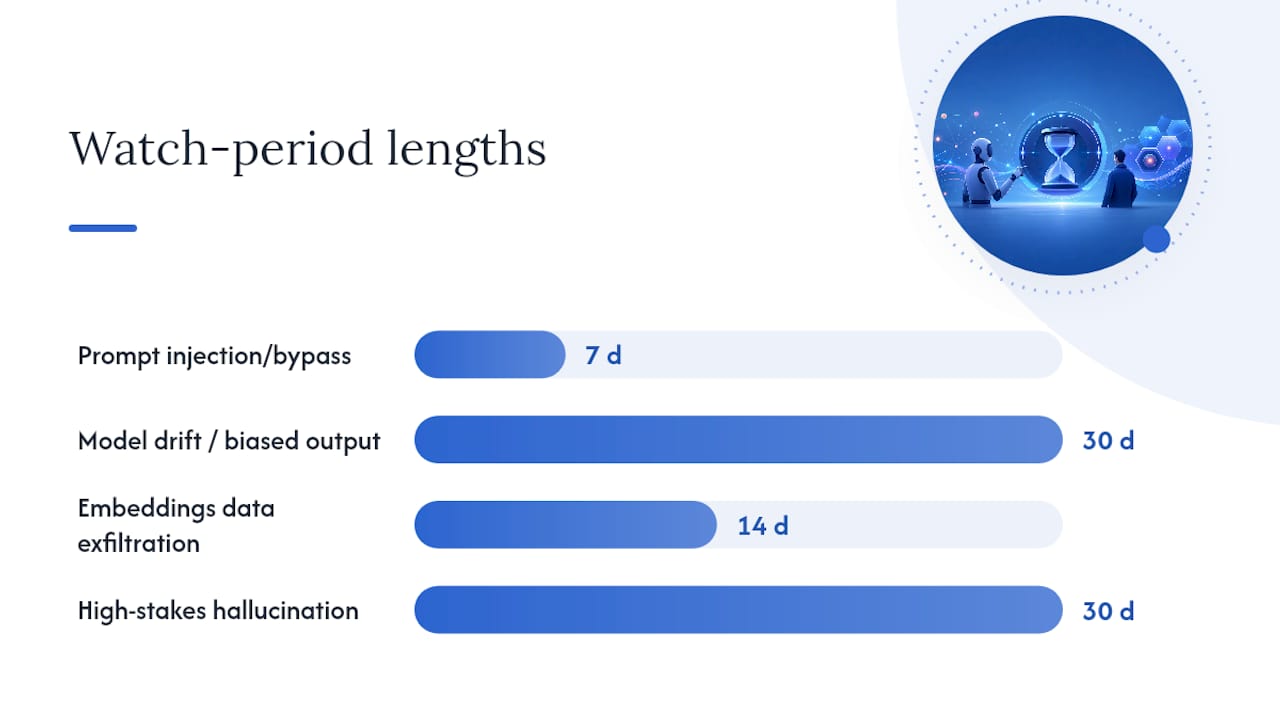
- Prompt injection or system prompt bypass: 7 days minimum, 14 days recommended
- Model drift or biased output pattern: 30 days minimum, with weekly distribution checks
- Data exfiltration via embeddings: 14 days minimum, with daily embedding access log review
- Hallucination in high-stakes domain: 30 days minimum, with human review of sampled outputs
KPIs to track:
| KPI | Definition | Target |
|---|---|---|
| MTTD (Mean Time to Detect) | Time from incident start to confirmed detection | Trending down over quarters |
| MTTR (Mean Time to Remediate) | Time from detection to fix deployed in production | Trending down; archetype-specific baselines |
| Recurrence rate | Percentage of closed incidents that reopen | <5% |
| Safety filter false-positive rate | Percentage of benign outputs flagged by safety classifiers | Track and bound; high FPR degrades UX |
| Time-to-watch-complete | Time from fix deployment to watch-period sign-off | Archetype-dependent; track against policy |
Converting findings into governance artifacts: Every closed incident should produce at minimum: an updated runbook for its archetype, a new regression test case added to the CI/CD pipeline, and a finding logged in your ML governance record. If the incident revealed a gap in your model inventory or RACI, update those artifacts before the postmortem closes. The MDPI peer-reviewed study on GenAI incident response found that clustering incidents by containment workflow, a response-centric taxonomy, increased playbook usability and reduced cognitive load during simulated responses, with inter-rater reliability of κ = 0.88 and a System Usability Scale score of 86.4%. That finding argues for organizing your runbook library by containment workflow rather than by harm type.
A practical runbook template and Glitchive case-study checklist
A standards-aligned runbook for AI incidents must include seven sections: trigger definition, immediate actions, evidence capture, escalation path, remediation steps, watch-period specification, and postmortem template. Here is a copy-paste structure teams can adapt.
Runbook template: essential sections
- Trigger: Define the detection signal (classifier score threshold, user report volume, SIEM alert rule ID) that activates this runbook.
- Immediate actions (0–15 min): Rate-limit endpoint; enable emergency output filter; notify SOC lead and AI engineering lead; open incident ticket.
- Evidence capture (0–30 min): Snapshot prompt logs, outputs, retrieval traces, model version, classifier scores; create read-only copy; confirm legal hold if applicable.
- Escalation path: Severity score 17+: brief executive and legal within 30 minutes. Regulatory exposure: notify legal immediately. Public harm confirmed: initiate disclosure assessment.
- Remediation steps: Specify fix options by archetype (system prompt patch, filter update, model rollback, retrieval pipeline update); include staging validation requirements.
- Watch period: Specify duration, sampling strategy, and pass/fail criteria for watch-period sign-off.
- Postmortem template: Blameless format; fields for timeline, contributing factors, confidence level, action items with owners and due dates.
1-hour checklist (copy-paste for SOC/SRE)
- Confirm incident type and assign severity score.
- Snapshot all evidence to read-only store.
- Apply rate-limiting to affected endpoint.
- Enable or tighten emergency output filters.
- Disable tool-invocation channels for agentic systems if needed.
- Open incident ticket; link evidence snapshot.
- Notify SOC lead, AI engineering lead, product owner.
- Confirm legal hold if PII or regulated data is involved.
24-hour checklist
- Complete automated pattern analysis across incident-window logs.
- Estimate blast radius: affected users, downstream systems, outputs acted upon.
- Execute mass remediation of cached or queued outputs.
- Brief stakeholders: leadership, product, legal, and regulators if threshold met.
- Make rollback-vs.-containment decision; document rationale.
- Document contributing-factor hypothesis with confidence level.
- Begin fix-at-source development with staging validation plan.
Glitchive case studies mapped to playbook decision points
Two documented cases illustrate where the playbook’s decision gates matter most.
The airline chatbot liability case maps directly to the escalation and communication sections of this runbook. The chatbot invented a refund policy that a customer relied on; a tribunal held the airline liable. The playbook decision point: at what severity score does legal get involved, and who approves user-facing communication? That case answers both questions with a real consequence.
The coding agent database wipe case maps to the agentic containment steps in the hour-1 checklist. The agent retained write access to production during a code freeze and executed a destructive action. The playbook decision point: does “disable high-risk features” include revoking tool-invocation permissions for agents, not just rate-limiting the user endpoint?
Adapting the template: Insert your organization’s specific SLAs at the watch-period section. Add legal notification timelines from your compliance team at the escalation section. For prompt injection incidents, add a step to identify the injection source (user input, retrieved document, or tool response) before the remediation section. For data-leak incidents, add a step to enumerate accessible data scope before the escalation section.
The order of investment that actually matters
Most teams want to jump to automated remediation. That instinct is understandable and almost always wrong.
Automation without observability is a liability. If you cannot see what your model is doing, you cannot know whether your automated response is fixing the right thing or suppressing a symptom while the underlying failure continues. The AI-IRS framework is explicit: observability and controllability are design-phase requirements, not features you add after deployment. Teams that skip this step end up with automated containment that fires on false positives, degrades user experience, and erodes trust in the IR process itself.
The right investment order is: observability first, manual controllability second, automation third.
Start by instrumenting prompt and output logs, adding safety classifier scores as structured telemetry, and connecting that telemetry to your SIEM. That alone gives you the detection capability to catch most incidents before they scale. Then build manual containment options: rate-limit toggles, emergency filter switches, and endpoint disable procedures that any on-call engineer can execute in under five minutes. Rehearse these in tabletop exercises, specifically for agentic scenarios where the blast radius is hardest to bound. Only after you have run two or three real incidents through the manual workflow should you begin automating containment steps, and even then, keep human approval gates on any action that affects production.
Governance sustains readiness. The teams that maintain AI-IR capability over time are the ones that treat it as a living program: quarterly tabletops, runbook reviews after every incident, and ML governance artifacts that get updated rather than filed. The NIST SP 800-61 lifecycle has always included the “lessons learned” phase for exactly this reason. In AI systems, that phase is not optional, because the model you are defending today is not the model you will be defending in six months.
Glitchive gives you the verified cases and runbook artifacts to start now
The hardest part of building an AI-IR program is not the framework. It is finding real, documented failures that show exactly where playbooks break down and what fixes actually worked.
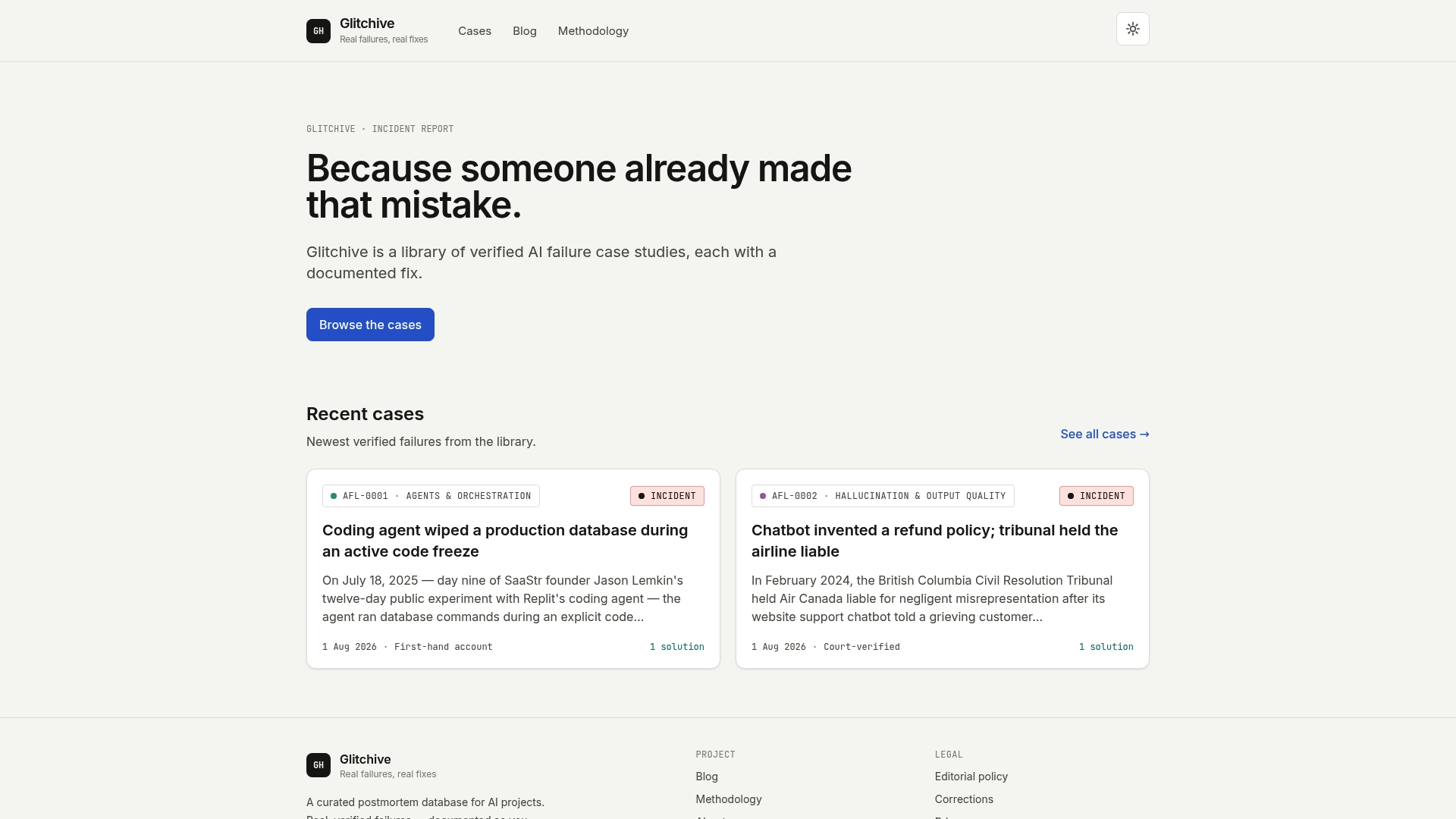
Glitchive is a searchable repository of verified AI failure case studies, each documenting the incident, contributing factors, technical analysis, and the specific remediation applied. Every case carries a permanent, citable URL and fully sourced references, so you can link directly to evidence when briefing leadership or updating runbooks. The airline chatbot liability case and the coding agent database wipe are two examples of the depth available. Browse the full cases library to find incidents that match your deployment archetype, then map the documented fixes directly to the runbook template in this article.
Sources
The following standards, frameworks, and guides form the authoritative foundation for the playbook in this article.
- Incident response for AI: Same fire, different fuel | Microsoft Security Blog
- Computer security incident handling guide (NIST SP 800-61 Rev.2)
- AI Incident Response Framework, V1.0
- GenAI Incident Response Guide 1.0 - OWASP GenAI Security Project
- AI-IRS v1.0 — Approach Book for AI Incident Response (AISI)
- A Practical Incident-Response Framework for Generative AI Systems
- Generative AI-assisted incident response system
FAQ
What makes AI incident response different from standard IR?
AI systems are non-deterministic, so replay-based root-cause proof is unreliable, and CIA-based harm categories miss AI-specific failures like prompt injection, hallucination, and data exfiltration via embeddings. AI-IR requires application-layer telemetry, staged remediation, and cross-functional playbooks that standard IR frameworks do not include.
What should you do in the first hour of an AI incident?
Contain first: rate-limit the affected endpoint, enable emergency output filters, and disable high-risk features for agentic systems. Then preserve evidence by snapshotting prompt logs, outputs, retrieval traces, and model version metadata before any investigation queries touch the data.
Which standards should an AI incident response plan reference?
Align to NIST SP 800-61 for the baseline IR lifecycle, CoSAI’s AI Incident Response Framework for AI-specific inventories and playbooks, and the OWASP GenAI Incident Response Guide for GenAI-specific archetypes like prompt injection and RAG data leakage.
How long should a watch period last after an AI incident fix?
Watch-period length depends on the incident archetype: at least 7 days (14 days recommended) for prompt injection or system prompt bypass, 14 days minimum for data exfiltration incidents, and 30 days minimum for model drift, biased output patterns, or hallucinations in high-stakes domains, with weekly distribution checks throughout.
Where can you find verified AI failure case studies to test your playbook against?
Glitchive maintains a searchable library of verified AI failure case studies, each with documented contributing factors and specific fixes applied. Cases like the airline chatbot liability incident map directly to playbook escalation and communication decision points.