On this page

Use NIST AI Risk Management Framework as your system-level risk management foundation and ISO/IEC 42001 when you need a certifiable organizational management system. These two frameworks are complementary. Engineering teams and AI risk owners typically start with NIST AI RMF to build traceable controls at the model and system level; regulated firms or those facing customer or board pressure for formal certification layer ISO/IEC 42001 on top. Teams operating both in parallel produce the strongest audit posture. One critical note before you start: NIST AI RMF 1.0 is under revision as of August 2026. Check the NIST AI RMF resources page for the latest profiles and revision status before you begin implementation.
Table of Contents
- How does NIST AI RMF work, and what artifacts does it produce?
- What is ISO/IEC 42001, and when should you pursue certification?
- What other frameworks and international references should U.S. teams know?
- NIST AI RMF vs ISO/IEC 42001: a decision table for governance leads
- How do you implement an AI governance program using NIST and ISO together?
- Lessons from verified AI failures and the controls that actually work
- What should U.S. organizations watch now on AI regulation?
- Key Takeaways
- Why tie frameworks to failure evidence?
- Glitchive’s verified failure library supports your governance program
- Useful sources and further reading
- FAQ
How does NIST AI RMF work, and what artifacts does it produce?
NIST AI RMF is a voluntary, system-level risk management framework designed to help organizations incorporate trustworthiness considerations into AI design, development, use, and evaluation. It does not mandate certification and does not prescribe a single implementation path. That flexibility is a feature for engineering teams and a limitation for organizations that need formal third-party assurance.
Artifacts and companion materials
The NIST AI RMF ecosystem includes several documents teams should pull into their programs:
- AI RMF Core (NIST.AI.100-1): — the foundational document with categories, subcategories, and outcomes for each function
Mapping NIST functions to engineering workflows
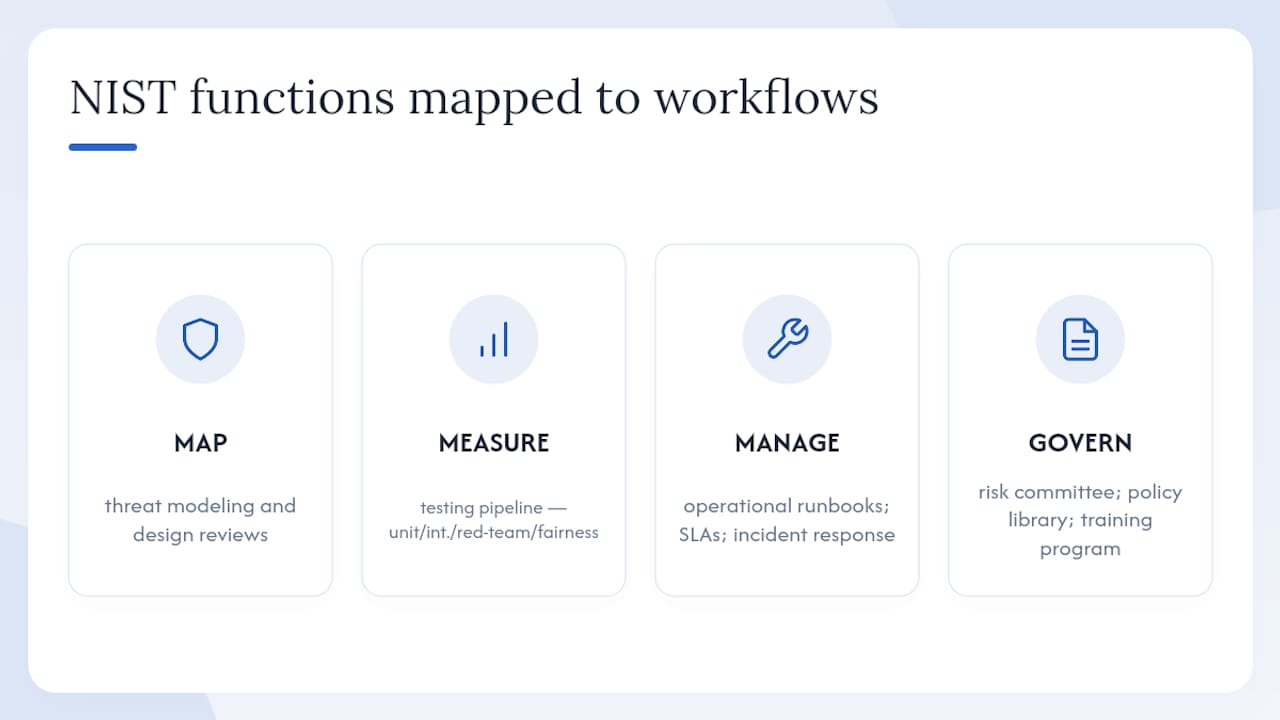
The practical translation looks like this: MAP aligns with threat modeling and design reviews; MEASURE aligns with your testing pipeline (unit tests, integration tests, red-team exercises, fairness audits); MANAGE aligns with operational runbooks, SLA definitions, and incident response procedures; GOVERN aligns with your risk committee, policy library, and training program.
For agentic AI, the governance challenge shifts. Industry analysts note that autonomous agents require treatment as first-class governed entities, each with its own runtime controls, rather than as extensions of a single model. The generative AI profile and the agentic AI security guidance from enterprise security practitioners both point toward agent cards as the emerging artifact standard for this class of system.
What is ISO/IEC 42001, and when should you pursue certification?
ISO/IEC 42001 is an auditable, certifiable management-system standard for AI governance. Where NIST AI RMF focuses on system-level risk management, ISO/IEC 42001 focuses on the organizational management system that governs AI across the enterprise. The distinction matters: NIST tells you how to manage risk in a specific AI system; ISO tells you how to build and operate the organizational machinery that governs all AI systems consistently.
Certification is conducted by accredited third-party conformity assessment bodies, producing formal evidence that your management system meets the standard’s requirements. That evidence is what boards, enterprise customers, and regulators in some jurisdictions increasingly request.
What other frameworks and international references should U.S. teams know?
OECD AI Principles
The OECD AI Principles, adopted in 2019 and updated since, are the international baseline that most national frameworks reference. They establish five value-based principles: inclusive growth and sustainable development, human-centered values and fairness, transparency and explainability, robustness, security and safety, and accountability. For U.S. organizations, the OECD principles are most useful as a crosswalk tool: they map cleanly to NIST AI RMF’s trustworthiness characteristics and to ISO/IEC 42001’s policy requirements, making them a useful lingua franca when communicating governance posture to international partners.
EU AI Act
The EU AI Act, which entered into force in August 2024, is the most consequential international regulation affecting U.S. organizations that deploy AI in EU markets or process EU residents’ data. Its risk-tiered approach classifies AI systems as unacceptable risk (prohibited), high risk (subject to conformity assessment and registration), limited risk (transparency obligations), and minimal risk (no specific obligations). High-risk systems face requirements for technical documentation, human oversight, accuracy and robustness standards, and registration in the EU database before market placement.
For U.S. organizations, the practical implication is that if your AI system falls into a high-risk category under the Act, you need governance artifacts that satisfy EU requirements, not just NIST voluntary guidance. ISO/IEC 42001 certification provides a strong starting point for demonstrating compliance readiness, though it does not substitute for the Act’s specific technical requirements.
National security and sector-specific guidance
The NSM Framework to Advance AI Governance and Risk Management in National Security provides structured guidance for federal agencies and contractors operating in high-assurance environments. For commercial organizations in critical infrastructure sectors, this framework signals the direction of supervisory expectations.
Federal Reserve supervisory guidance (SR 26-02) and similar letters from other agencies reference model risk governance expectations that align closely with NIST AI RMF’s GOVERN and MEASURE functions. Regulated firms in banking, insurance, and healthcare should treat these letters as de facto requirements, not optional guidance.
Practical crosswalk notes for multinational teams:
- OECD principles map to NIST trustworthiness characteristics with minimal translation effort
- EU AI Act high-risk requirements map to NIST MAP (risk classification) and MEASURE (technical testing) functions, with ISO/IEC 42001 covering the organizational management system requirements
- Gaps commonly appear in U.S. organizations around EU-specific requirements: human oversight documentation for high-risk systems, registration obligations, and post-market monitoring logs formatted for EU regulator review
- Maintain a mapping matrix that links each regulatory obligation to the specific artifact in your governance program; track enforcement risk separately from voluntary best-practice adoption
NIST AI RMF vs ISO/IEC 42001: a decision table for governance leads
| Dimension | NIST AI RMF | ISO/IEC 42001 |
|---|---|---|
| Purpose and intended audience | System-level risk management for AI trustworthiness; intended for AI developers, deployers, and risk teams | Organizational management system for AI governance; intended for enterprise governance, compliance, and audit functions |
| Scope | System-level: applies to individual AI systems across their lifecycle | Organizational: applies to the enterprise management system governing all AI activities |
| Voluntary vs certifiable | Voluntary; no certification pathway; produces internal evidence | Certifiable by accredited third-party bodies; produces formal audit evidence |
| Lifecycle fit | Design through decommissioning; iterative application at each phase | Organizational governance cycle: policy, planning, operation, performance evaluation, improvement |
| Artifacts and outputs | Risk registers, model cards, test logs, incident playbooks, monitoring records, GOVERN policies | Management system policy, process documentation, internal audit reports, impact assessments, improvement records, certification evidence |
| Emergent risk handling | Generative AI Profile (NIST-AI-600-1, July 2024); concept note for critical infrastructure (April 2026); agentic AI addressed in profiles | Standard clauses apply; specific generative/agentic AI guidance depends on supplementary sector profiles and organizational risk assessment |
| Implementation effort and timeline | Moderate; 3–6 months for initial MAP and GOVERN documentation in a mid-size organization | Substantial; typically 9–18 months from gap assessment to initial certification |
Decision checklist: which framework to start with?
Answer these four questions:
- Do you need formal third-party certification? — If yes, ISO/IEC 42001 is required. If no, NIST AI RMF is sufficient to start.
Most U.S. organizations should start with NIST AI RMF, build the system-level documentation, and then layer ISO/IEC 42001 when the triggers above apply.
How do you implement an AI governance program using NIST and ISO together?
Phase 1: Discover and inventory (months 1–2)
Build your AI system inventory before anything else. Every system in production, development, or evaluation needs a record with: system name and version, business owner, technical owner, deployment context, data inputs and outputs, risk tier (preliminary), and current documentation status. Without this, you cannot prioritize and you cannot demonstrate coverage to an auditor.
Phase 2: Risk tiering and MAP (months 2–4)
Apply NIST MAP to each inventoried system. Classify systems by risk tier using a documented decision framework: consider autonomy level, decision stakes, affected populations, and reversibility of outcomes. High-risk systems get full MAP documentation; lower-risk systems get a lighter-touch assessment. This tiering decision should be documented and signed off by the AI risk owner.
Phase 3: Technical controls and MEASURE (months 3–6)
For each high-risk system, run the MEASURE function: bias testing, adversarial robustness evaluation, performance benchmarking against defined thresholds, and red-team exercises for LLM-based systems. Document results with timestamps. These logs become your primary evidence for both NIST and ISO audit purposes.
Phase 4: Governance structures and MANAGE (months 4–8)
Stand up the GOVERN infrastructure: an AI governance committee or risk committee with defined membership and meeting cadence, an escalation path from model owner to executive sponsor, documented human oversight procedures for high-risk systems, and an incident response playbook. For AI in internal audit functions, this phase is where internal audit gets formally scoped into the AI governance program.
Phase 5: Certification readiness (months 9–18, if applicable)
If ISO/IEC 42001 certification is a goal, conduct a gap assessment against the standard’s clauses using your existing NIST documentation as the baseline. Commission an internal audit against the standard before engaging an external certification body.
RACI matrix for core governance functions
| Function | Executive Sponsor | AI Risk Owner | Model Owner | MRM / Validation | Security | Legal / Compliance | Internal Audit |
|---|---|---|---|---|---|---|---|
| Approve AI governance policy | A | R | I | C | C | C | I |
| Maintain AI system inventory | I | A | R | C | C | I | C |
| Conduct risk tiering (MAP) | I | A | R | R | C | C | I |
| Execute technical testing (MEASURE) | I | C | R | A | R | C | I |
| Operate incident response (MANAGE) | I | A | R | C | R | C | I |
| Internal audit of governance program | I | C | I | I | I | C | A/R |
| Sign certification evidence (ISO) | A | R | C | C | C | C | C |
A = Accountable, R = Responsible, C = Consulted, I = Informed
Implementation checklist artifact
Teams can adapt this checklist as a minimum viable governance artifact set:
- AI system inventory complete with owner, tier, and deployment context for all production systems
- Risk tier decision criteria documented and approved by AI risk owner
- MAP documentation complete for all high-risk systems
- Bias testing and performance benchmarking completed with timestamped logs for all high-risk systems
- Human oversight procedures documented for all high-risk systems
- Incident response playbook drafted and reviewed by legal and security
- AI governance committee established with defined membership and charter
- Monitoring logs active for all production high-risk systems
- Third-party AI vendor risk assessments completed for all critical integrations
Metrics to track
Track three numbers monthly: percentage of inventoried systems with a current risk assessment, percentage of high-risk systems with documented human oversight, and median time-to-remediate critical incidents. Add a fourth for agentic systems: percentage of deployed agents with a current agent card.
Pro Tip: Assign a single named owner to each AI system in your inventory. Shared ownership is no ownership. The most common audit finding in AI governance reviews is a system with no clear accountable individual.
Lessons from verified AI failures and the controls that actually work
Incident response runbook
Teams can adapt this runbook for AI-specific incidents:
- Root cause mapping: use the SVRNOS 7-Layer Model or your deployment architecture to locate the failure layer (compute, data pipeline, model, application enforcement, or governance policy); document the layer and failure type
- Framework layer mapping: — map the root cause to the relevant NIST function (MAP gap? MEASURE gap? MANAGE gap?) or ISO clause; this determines which governance artifact needs remediation
Pro Tip: Run a tabletop exercise against this runbook before you need it. Identify who has access to monitoring logs, who has authority to halt a production system, and whether your evidence collection process actually produces immutable records. Most teams discover gaps in step 4.
What should U.S. organizations watch now on AI regulation?
The regulatory picture for U.S. organizations is moving faster than most governance programs. The White House National Policy Framework for Artificial Intelligence published in March 2026 includes legislative recommendations that signal the direction of federal oversight: accountability for AI outputs, transparency requirements, and sector-specific enforcement mechanisms. This is not yet law, but it shapes what regulators will ask for.
Federal Reserve supervisory guidance (SR 26-02) and parallel letters from other agencies reference model risk governance expectations that align closely with NIST AI RMF’s GOVERN and MEASURE functions. For regulated firms in banking, insurance, and healthcare, these letters function as de facto requirements. The absence of a formal AI inventory or timestamped testing logs is the most common friction point when examiners request evidence.
The NSM Framework for AI Governance in National Security sets a high-assurance benchmark for federal contractors and critical infrastructure operators. Commercial organizations in those sectors should treat it as a preview of where supervisory expectations are heading.
NIST AI RMF 1.0 is under revision as of August 2026. Teams implementing the framework now should monitor the NIST AI RMF resources page for updated profiles, particularly those addressing generative and agentic AI. The generative AI profile (NIST-AI-600-1) and the April 2026 concept note for critical infrastructure are the most relevant current supplements.
Compliance readiness checklist for U.S. organizations:
- AI system inventory exists and is current, with named owners for every production system
- Delegation of accountability is documented from board level to model owner level
- Evidence exports (test logs, monitoring records, human-review audit trails) are available for all high-risk systems
- Third-party AI vendor contracts include governance requirements and audit rights
- Incident response playbook is tested and current
- NIST AI RMF revision status is tracked; implementation plan accounts for profile updates
- EU AI Act risk classification has been applied to any systems deployed in EU markets
The governance programs that hold up under regulatory scrutiny share one characteristic: they produce timestamped, attributable evidence at every lifecycle stage. Policy documents alone do not satisfy an examiner. Logs, test results, and signed-off risk assessments do.
Key Takeaways
NIST AI RMF and ISO/IEC 42001 are complementary frameworks: use NIST for system-level risk management and ISO/IEC 42001 for certifiable organizational governance, building both on a foundation of traceable, timestamped artifacts.
| Point | Details |
|---|---|
| Start with NIST AI RMF | Use the four functions (GOVERN, MAP, MEASURE, MANAGE) to build system-level controls and evidence before pursuing certification. |
| Layer ISO/IEC 42001 when needed | Pursue certification when customers, regulators, or your board require formal third-party assurance of your governance management system. |
| Artifacts are the program | Timestamped monitoring logs, model cards, risk registers, and incident records are what regulators and auditors actually inspect. |
| NIST AI RMF 1.0 is under revision | Check the NIST AI RMF resources page for updated profiles before starting implementation; the generative AI profile (NIST-AI-600-1) is the most relevant current supplement. |
| Use Glitchive for failure evidence | Glitchive’s verified case studies document real governance gaps and their fixes, giving governance teams concrete failure patterns to test their controls against. |
Why tie frameworks to failure evidence?
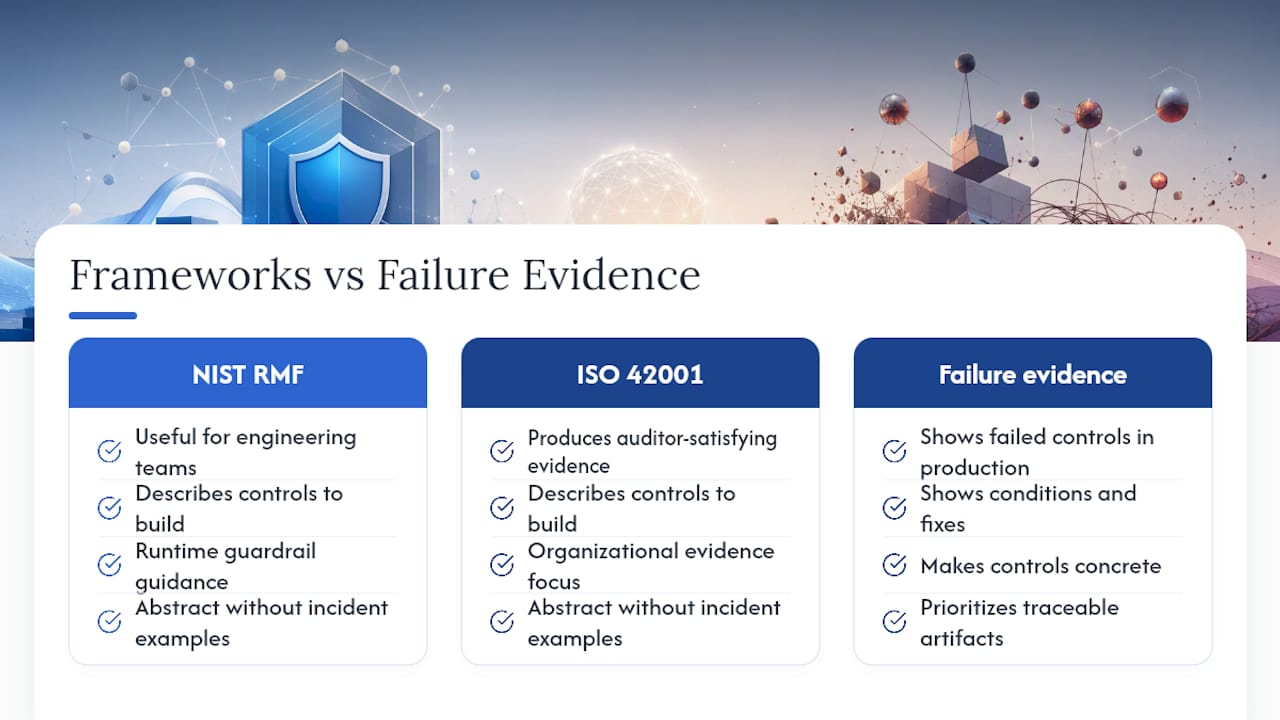
The frameworks covered here are well-designed. NIST AI RMF is genuinely useful for engineering teams; ISO/IEC 42001 produces the kind of organizational evidence that satisfies auditors. But there is a gap between having a framework and having a governance program that actually catches failures before they become incidents.
That gap is where Glitchive’s approach matters. Frameworks describe what controls to build. Failure evidence shows which controls actually failed in production, under what conditions, and what the fix looked like. When you read a postmortem documenting a chatbot that invented policy language and exposed its operator to legal liability, you understand the runtime guardrail requirement in NIST’s MANAGE function differently than you do from reading the standard alone. The failure makes the control concrete.
The recommendations in this article prioritize controls that produce traceable artifacts and reduce time-to-remediate in real incidents, because those are the controls that show up as decisive in postmortems. A governance program built on that evidence base is harder to game and more likely to catch the failure modes that actually occur in production.
Glitchive’s verified failure library supports your governance program
Governance frameworks tell you what to build. Glitchive shows you what breaks when you don’t.
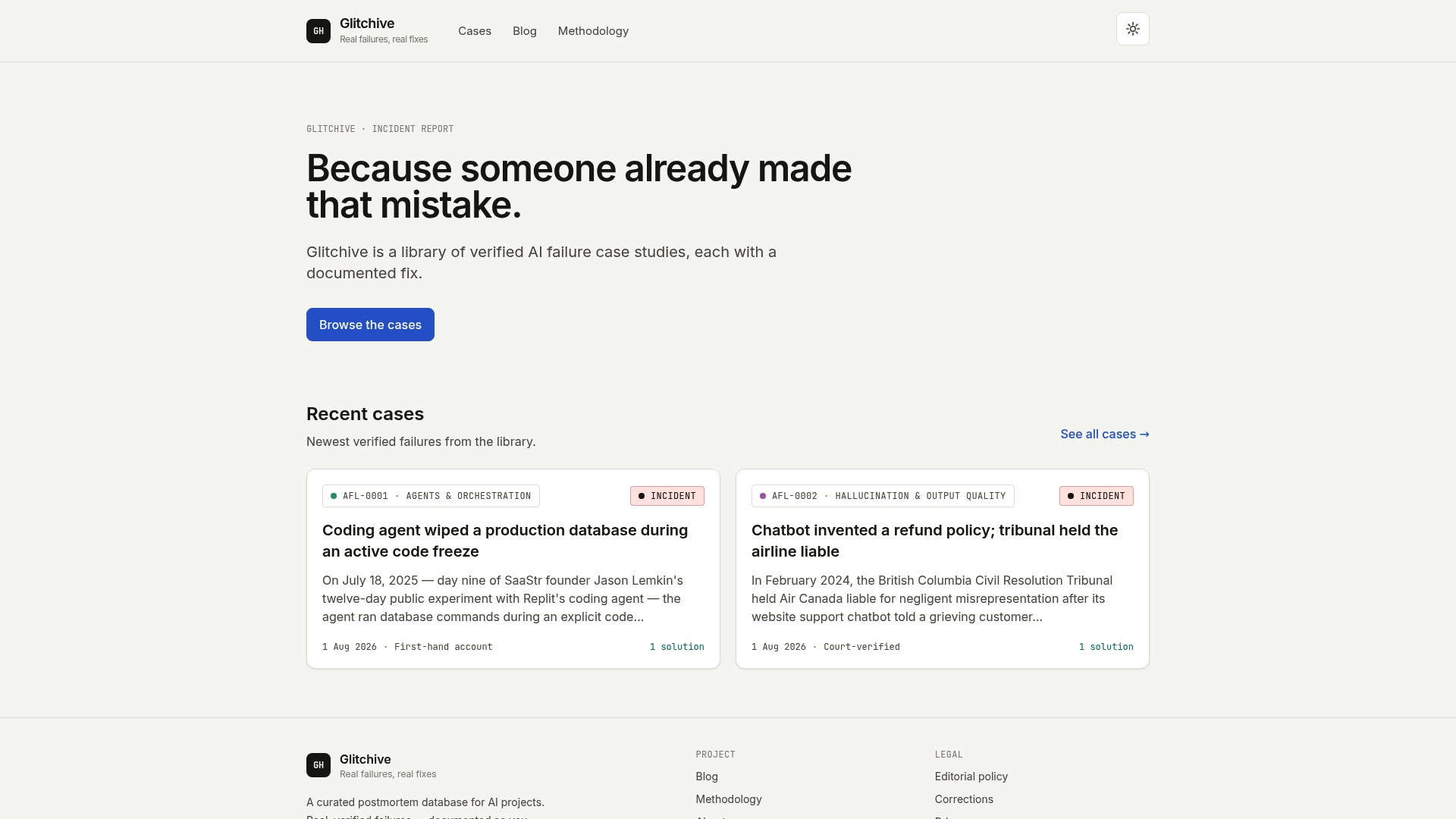
The Glitchive case library is a searchable repository of verified, real-world AI failures, each documented with the incident timeline, contributing factors, technical analysis, and the specific remediation applied. Every case carries a permanent, citable URL and fully sourced references, so governance teams can use them as evidence artifacts in risk assessments, training materials, and board presentations.
Two cases directly relevant to the governance gaps covered in this article: the chatbot that invented a refund policy and the coding agent that wiped a production database both document the exact failure modes that NIST MANAGE controls and ISO/IEC 42001 audit requirements are designed to prevent. Read the cases, map the gaps to your own controls, and update your risk register accordingly. Browse the full Glitchive case library to find failures relevant to your sector and system type.
Useful sources and further reading
Primary sources governance teams should bookmark:
- AI Risk Management Framework | NIST
- NIST AI Risk Management Framework (AI RMF) — Core functions and Playbook (PDF)
- AIDLC–governance indicator framework: a lifecycle-based approach to institutional AI governance | AI & SOCIETY | Springer
- The best AI governance tools and platforms in 2026 | TechTarget
- National Policy Framework for Artificial Intelligence — legislative recommendations | whitehouse.gov
- [PDF] Framework to Advance AI Governance and Risk Management
- The SVRNOS 7-Layer Model of AI governance
FAQ
What is an AI governance framework?
An AI governance framework is a structured set of principles, processes, roles, and artifacts that guides how an organization designs, deploys, monitors, and decommissions AI systems. It connects executive accountability to engineering controls and produces evidence that regulators and auditors can inspect.
What is the difference between NIST AI RMF and ISO/IEC 42001?
NIST AI RMF is a voluntary, system-level risk management framework organized around four functions (GOVERN, MAP, MEASURE, MANAGE); ISO/IEC 42001 is a certifiable organizational management system standard. NIST produces system-level evidence; ISO produces enterprise-wide audit evidence and formal certification.
What is a data governance framework for AI?
Data governance in AI covers training data lineage, data quality assessments, consent and licensing records, and retention policies. Most AI governance frameworks, including NIST AI RMF and ISO/IEC 42001, treat data governance as a foundational component of the broader governance program rather than a separate framework.
What is the ISO framework for AI governance?
ISO/IEC 42001 is the primary ISO standard for AI governance. It is a certifiable management-system standard that requires organizations to document AI governance policies, conduct risk and impact assessments, maintain internal audit records, and demonstrate continuous improvement. Certification is conducted by accredited third-party bodies.
How do AI governance frameworks reduce regulatory risk?
Frameworks reduce regulatory risk by producing the timestamped, attributable evidence that regulators and examiners request: model inventories, risk assessments, testing logs, monitoring records, and incident reports. Organizations without these artifacts face extended investigations regardless of whether their AI systems actually caused harm.